
Your business operates as one. Your transformation environment should too.
Disconnected processes, architectures and governance structures are slowing transformation, increasing complexity and limiting AI adoption. This white paper explores why unified operational models are emerging as the new foundation for enterprise transformation.
14-page executive white paper. Based on research across 600 leader interviews. Free download. No sales call required.

















Record investment. Persistent transformation friction.
The challenge is no longer a lack of technology investment. It is the growing disconnect between operational processes, enterprise architecture, governance and execution visibility.
Bain & Company, 2024
Gartner
McKinsey & Company, 2023
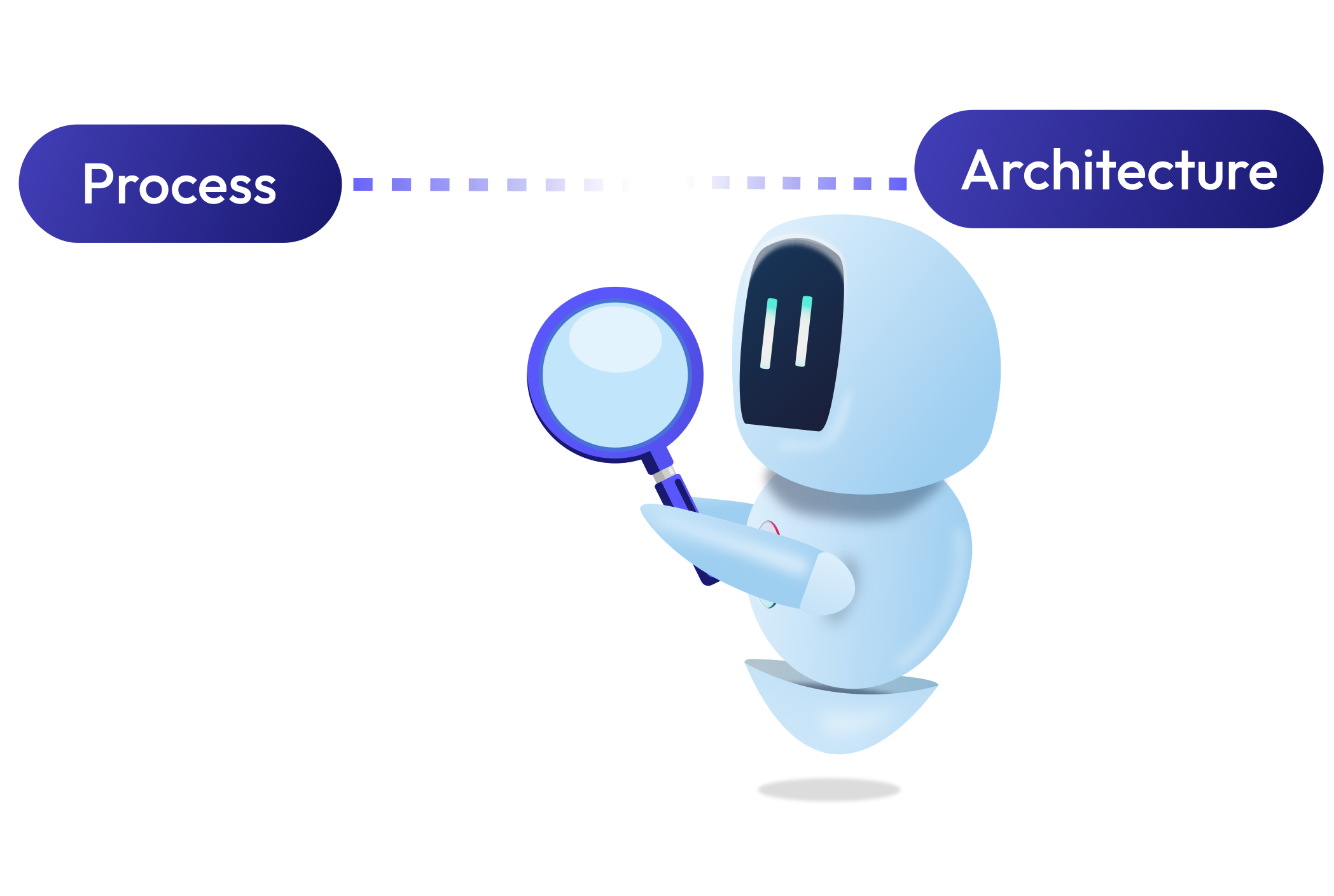
From scattered disciplines to a unified transformation engine
AI is exposing operational fragmentation
87% of leaders agree that agentic AI requires structured, governed processes to deliver value. Only 17% of organisations currently operate at that level. The majority are attempting to layer AI on a foundation that cannot support it – accelerating chaos rather than eliminating it.
Operational complexity is accelerating
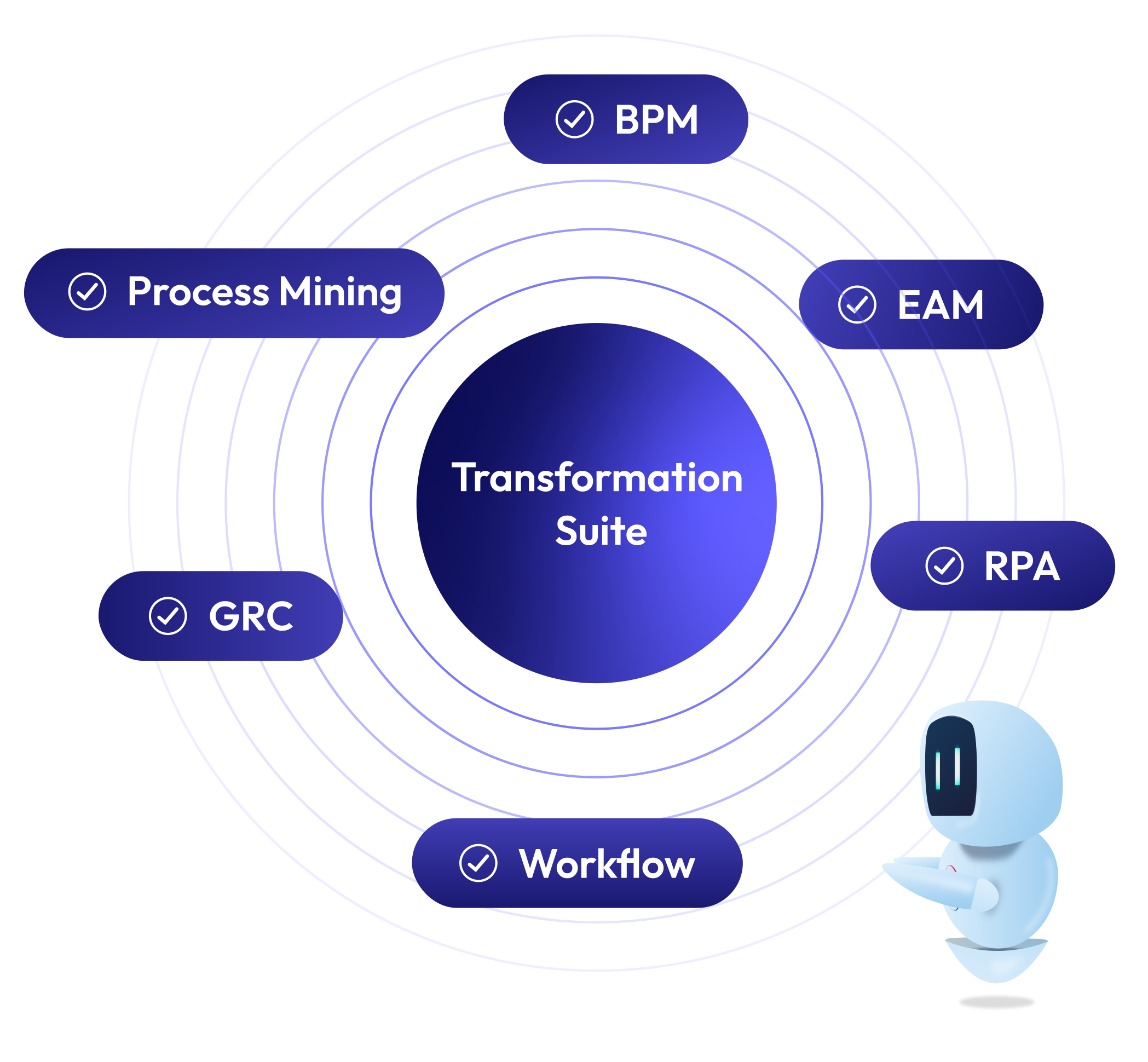
Cloud transformation, platform consolidation, cybersecurity requirements and global operating models are increasing dependency complexity across enterprises. Yet most organisations still manage BPM, EAM and governance through disconnected tooling and isolated operational views.
Transformation leaders require operational intelligence
CIOs, enterprise architects and transformation leaders are increasingly expected to model change, assess dependencies, evaluate operational risk and guide transformation decisions with confidence. That requires connected visibility across both process and architecture.

The majority condition – not the minority exception
Most organisations have invested significantly in BPM tools, EAM platforms and GRC systems. They have dedicated teams for each. The problem is not the quality of those individual functions. It is the absence of a unifying framework that connects them.
Process models don't connect to the IT systems that support them. Architecture repositories don't reflect how work actually happens. Risk and compliance functions assess controls without being embedded in operational processes. Each discipline operates in its own system, with its own data and its own version of the truth.
The result is predictable: transformation programmes built on fragmented foundations.
Processes are redesigned without understanding system dependencies. Architecture decisions are made without accurate process knowledge. Compliance is bolted on after the fact – creating friction, audit risk and costly rework.
This is not a description of poorly resourced organisations. It is the structural default for many large enterprises, including organisations with mature, well-funded teams across every discipline.
Five dimensions of unified transformation
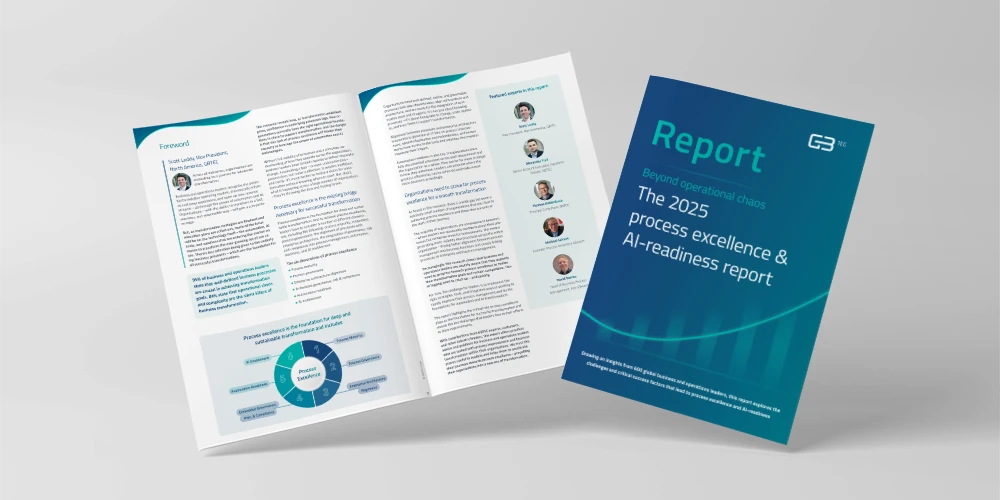
The white paper goes beyond the problem statement. It provides a practical framework for CIOs, Chief Architects, CROs and transformation leaders ready to move from fragmented to unified.
Transformation involves technology deployment, so organisations need to understand how software applications fully support and enable defined processes. Without this connection, transformation is architecturally unsound from the start.

Unified business context for scalable AI
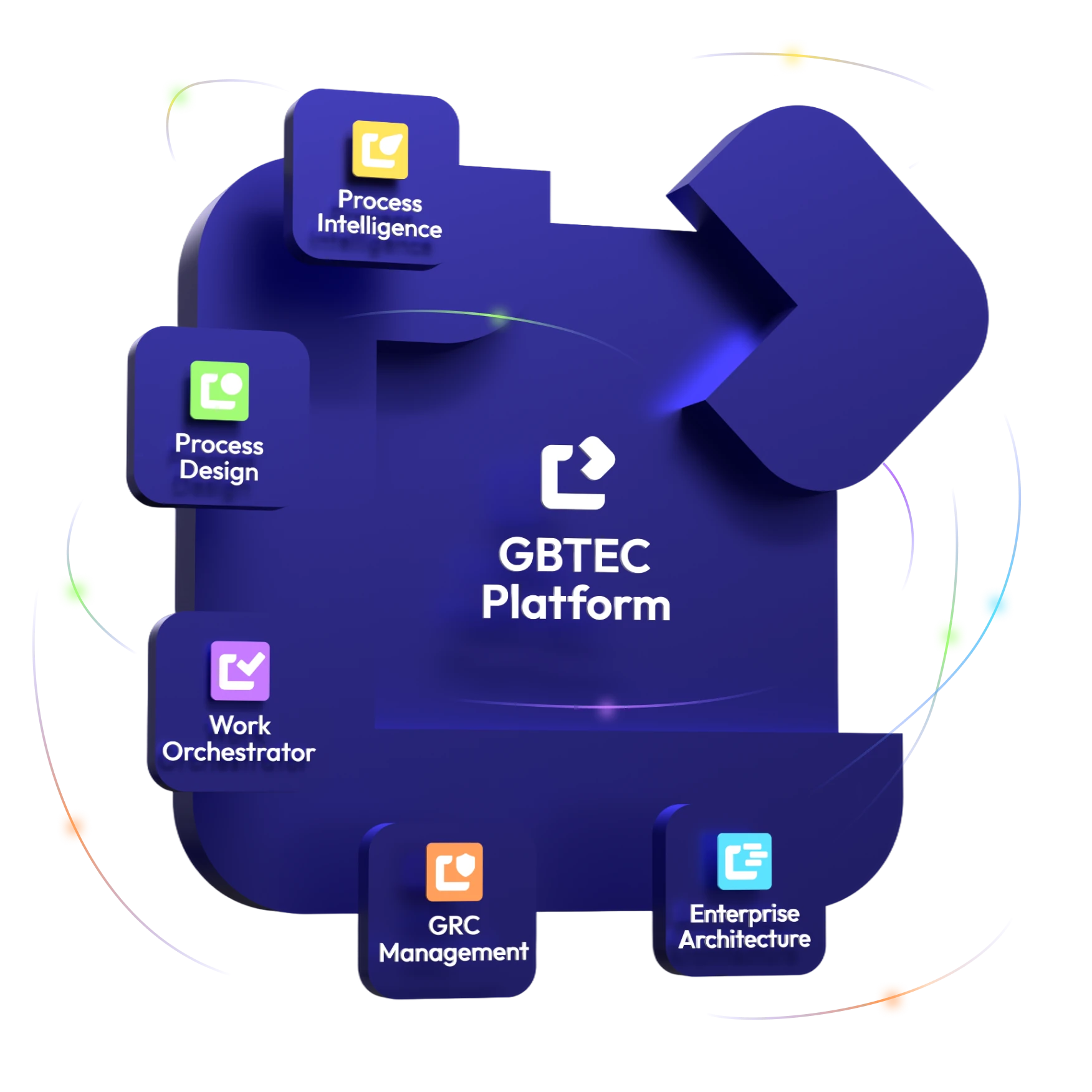
The GBTEC Platform brings together Business Process Management (BPM), Enterprise Architecture Management (EAM), and Governance, Risk, and Compliance (GRC) in a connected operating model. The resulting business context and a transparent, consistent view of processes create the foundation for deploying and scaling AI across the organisation.
The platform also features Arty, an integrated AI assistant that makes connected knowledge accessible and supports employees in their day-to-day work.
- Single data model – no synchronisation lag
Processes, systems, risks, and controls operate within a shared data structure. Changes become visible across BPM, EAM, and GRC instantly, without reconciliation layers or middleware complexity. - Living Digital Twin of an Organisation – built natively
The DTO is the natural endpoint of connected BPM and EAM practice. GBTEC Platform provides the shared data model that makes a genuine, real-time organisational twin achievable. - GRC embedded – not bolted on
Controls, risks, and compliance requirements are connected directly to operational processes and supporting systems. This improves traceability, impact analysis, and audit readiness while reducing manual governance overhead. - AI and automation on a governed foundation
AI-powered process discovery, no-code automation, and agentic AI deployment,all within a governed, architecturally grounded process environment. Structured foundations for reliable AI.

Find out if your organisation is building on a connected foundation – or papering over the gap.
The white paper takes less than 20 minutes to read. The questions it raises will reshape how you think about your transformation programme.
GBTEC Software AG
Gesundheitscampus-Süd 23
44801 Bochum
Germany
