




From silos to a single source of truth: What poor operational visibility really costs
 20 October 2026
Ask two teams to describe the same end-to-end process, and their answers may differ considerably. Each team may understand its own activities, yet neither may have a complete view of the handovers, systems, controls, and exceptions that connect the work across the organisation.
This is an operational visibility problem. Operational visibility is an organisation’s ability to understand how work flows across departments, locations, systems, and roles, including the dependencies, variants, and exceptions that shape day-to-day execution.
Limited operational visibility is more than a documentation issue. It affects efficiency, decision-making, transformation, governance, and the ability to scale automation and AI. When an organisation cannot see how work operates as a whole, it must reconstruct that picture whenever a problem or proposed change crosses a functional boundary.
What causes operational blind spots?
Operational blind spots rarely result from a complete lack of process knowledge. More often, relevant knowledge is distributed across separate sources that reflect different perspectives.
A process team may maintain the designed process while operational teams rely on local instructions and experience. Enterprise Architecture may document applications without showing how individual process steps depend on them. Risk and compliance teams may maintain controls elsewhere, and important exceptions may exist only in the knowledge of experienced employees.
Each source may be useful on its own, yet still fail to provide business process visibility across the organisation. Blind spots tend to emerge when:
Processes are managed within department silos. Teams can explain their own work but not the full end-to-end flow or the effects of a change elsewhere.
Teams use different tools and conventions. Process knowledge becomes difficult to compare, reconcile, and govern across locations and functions.
Variants are not managed centrally. Local differences exist without a reliable way to distinguish necessary variation from unmanaged inconsistency.
Dependencies remain implicit. Relationships between processes, systems, roles, data, risks, and controls become visible only when something changes or fails.
Operational knowledge depends on individuals. When experienced employees are unavailable or leave, important process context becomes difficult to recover.
What process silos actually cost
When departments maintain separate versions of a process, the effects can be felt across performance, quality, change, and control. These costs are not always attributed to process silos because they arise in different teams and budgets.
Duplicated work and rework. The same activity may be performed in different ways across locations, while unclear handovers create gaps, repeated checks, and manual correction.
Errors and exception drift. Inconsistent inputs and execution increase variation in outcomes. Without a shared baseline, exceptions are harder to identify and may gradually become accepted practice.
Slower decisions. Teams spend time establishing how work currently operates before they can assess an issue, compare options, or agree on a response.
More expensive change. Improvement and transformation programmes repeatedly reconstruct the current state because process knowledge is fragmented or outdated.
Governance and audit exposure. Processes that are not connected to ownership, controls, and evidence are harder to govern, explain, and verify.
Key-person dependency. Critical context remains with the people who know how the work actually happens instead of becoming part of organisational knowledge.
A shared, standardised process landscape can reduce rework, improve consistency, and help teams identify operational risks earlier. The scale of improvement depends on the organisation’s starting point, scope, and implementation.
How operational blind spots slow down decision-making
Operational decisions often depend on understanding what will be affected, who needs to be involved, and which constraints apply. Without operational transparency, answering these questions becomes an information search rather than part of the decision itself.
Teams arrange workshops to reconcile different process versions. Process owners are asked to confirm dependencies that have never been documented. System and control implications are pieced together through interviews. By the time the organisation agrees on the current state, the issue may have changed or the available response window may have narrowed.
A trusted process view does not remove judgement or discussion. It gives those discussions a shared starting point, allowing teams to focus on the implications of a decision rather than first debating how the process works.
Why transformation becomes more expensive
Transformation programmes need a reliable view of the current state. When that view is incomplete, scope, resource estimates, and timelines rest on assumptions that may not hold across the organisation.
Unknown process variants may emerge during design or testing. Application dependencies may become visible only when a system is changed. Control requirements may be identified after a future-state process has already been approved. Each late discovery creates additional analysis, redesign, coordination, or validation work.
This is one reason transformation programmes can take longer than expected even when programme governance is sound: part of the effort is spent rebuilding operational context that was not available at the outset.
Why AI and automation struggle to scale
Fragmented and inconsistently defined processes are one reason AI and automation pilots can struggle to scale beyond their initial environment. A local pilot may work because the team understands its own data, exceptions, controls, and workarounds. Other teams may execute the same process differently.
Scaling requires more than reproducing the technology. The organisation needs to understand whether inputs, decisions, approval thresholds, systems, and exception paths are sufficiently consistent across the intended scope. Otherwise, a solution designed for one context may behave inconsistently or require substantial redesign elsewhere.
Operational visibility makes these differences explicit. It helps teams identify where a common approach is viable, where variants need to be preserved, and which controls and human decisions must remain part of the process.
From fragmented knowledge to a single source of truth
Improving operational visibility usually requires more than adding another tool within one department. It requires a consistent way to manage process knowledge across the organisation.
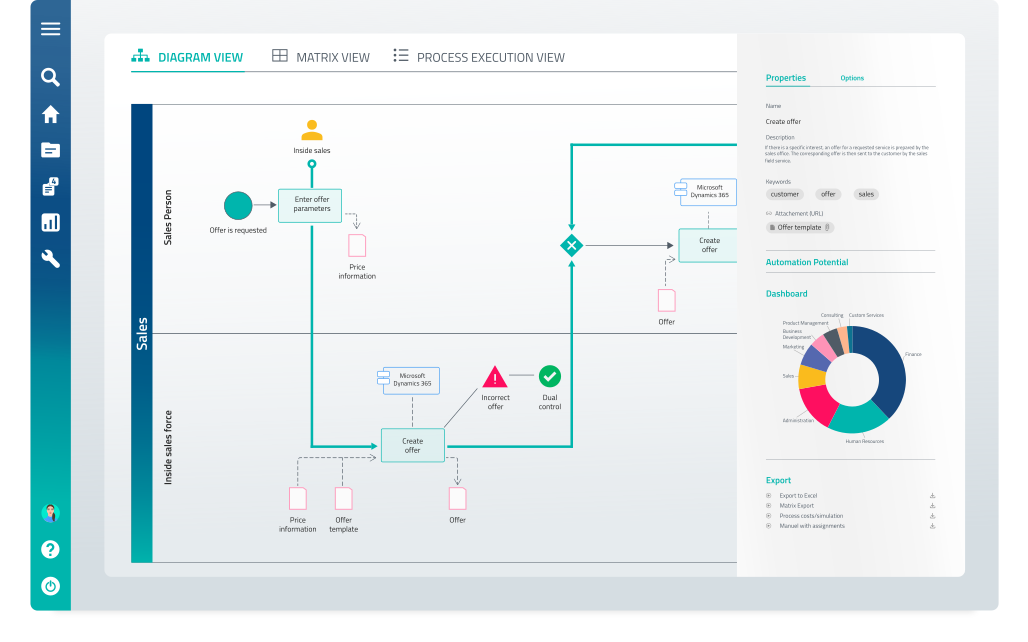
A single source of truth does not necessarily mean storing every operational artefact in one system. It means maintaining one trusted process view that connects the relevant roles, systems, controls, variants, handovers, and dependencies. Supporting information may remain in specialist systems, provided that the relationships required to understand the process are visible and governed.
This shared view supports process standardisation without assuming that every location or team must work identically. It establishes a common baseline, makes necessary variants explicit, and gives process governance a clear object to review and maintain.
The practical result is greater operational transparency. Employees can see how their work connects to the wider process, transformation teams can trace likely impacts, and AI and automation teams can assess use cases against a more reliable operational picture.
How to assess operational visibility
Start with one end-to-end process that crosses departments or systems. Then test whether the organisation can answer five questions consistently:
Can teams describe the same process in the same way? Differences may reveal fragmented process knowledge or unmanaged variants.
Are handovers visible and clearly owned? Look for points where responsibility, information, or work moves between teams.
Are variants documented and deliberately governed? Confirm which differences are necessary and which have developed without a clear decision.
Can teams trace the supporting systems, roles, and controls? These relationships influence how reliably changes and proposed use cases can be assessed.
Does operational evidence support the documented process? Employee input, system data, and process mining can help test whether the shared view reflects day-to-day execution.
The assessment does not need to cover the entire organisation at once. One cross-functional process can reveal where operational knowledge is clear, where it remains fragmented, and which gaps create the greatest barrier to improvement.
Establish your baseline
A maturity assessment can provide a broader view of how processes are documented, standardised, centralised, governed, and prepared for automation and AI. The result is most useful when it reflects actual practice rather than the intended operating model.
Use the findings to identify which dimension needs attention first. Some organisations need basic process visibility. Others have extensive documentation but lack adoption, governance, or a consistent way to manage variants across teams and locations.
Take the 5-minute Digital Maturity Assessment
Assess your organisation across transparency and visibility, standardisation and consistency, centralisation and a single source of truth, governance and compliance, and automation and AI readiness. Receive a personalised baseline and recommended next steps.
Frequently asked questions
What is operational visibility?
Operational visibility is an organisation’s ability to understand how work flows across departments, locations, systems, and roles. It includes handovers, dependencies, variants, controls, and exceptions that influence how processes operate in practice.
What causes operational blind spots?
Operational blind spots arise when process knowledge is fragmented across teams, tools, files, and individual experience. They are reinforced when variants, system dependencies, controls, and handovers are not maintained as part of a shared process view.
How do process silos affect business performance?
Process silos can create duplicated work, inconsistent outcomes, unclear handovers, slower decisions, and repeated current-state analysis. They can also make operational risks and dependencies harder to identify before changes are implemented.
Why do AI and automation struggle to scale across departments?
A use case designed for one team may rely on different inputs, systems, controls, and exception paths from those used elsewhere. Operational visibility helps teams identify these differences and decide what can be standardised before expanding the solution.
How can organisations improve operational visibility?
Begin with one end-to-end process, connect the relevant roles, systems, controls, handovers, and variants, and compare the documented view with operational evidence. Assign ownership for maintaining that process knowledge and make it accessible to the teams that use and govern it.
GBTEC Software AG
Gesundheitscampus-Süd 23
44801 Bochum
Germany
