




5 misconceptions holding back Integrated Risk Management
 24 July 2026
 Why a holistic view of risk is often missing
Most organisations have established structures for Risk Management, Internal Controls, Information Security, Business Continuity, and Compliance. Yet many still struggle to address risks systematically and reliably assess their impact on the business.
Individual departments typically have proven methods, clearly defined processes, and extensive data at their disposal. What matters, though, is whether relevant information can also be viewed and used in context. After all, the true criticality of a risk only becomes clear when its impact on the entire organisation is taken into account. Without this broader context, important connections that are essential for effective risk governance remain hidden. This is where Integrated Risk Management (IRM) comes in: it connects GRC (Governance, Risk, and Compliance) information and creates a consolidated view of an organisation's overall risk position.
In practice, however, this holistic approach often runs up against a set of assumptions that have taken hold over the years. Many of them sound plausible at first glance, which is why they are rarely questioned. But amid growing regulatory demands, interconnected business processes, and mounting uncertainty, these misconceptions frequently prevent organisations from realising the full potential of integrated GRC management.
Misconception 1: “If every department manages its own risks effectively, the organisation has overall risk under control.”
This assumption sounds reasonable at first. After all, each department knows its own risks best and usually has established methods for managing them. In practice, however, risks rarely stay within organisational boundaries.
A cyberattack, for example, is rarely just an Information Security issue. It can disrupt critical business processes, trigger extensive emergency measures, cause significant financial damage, and set off statutory reporting obligations, often all at once. The same applies to supply chain disruptions, process failures, or new regulatory requirements, whose effects frequently span several parts of the business.
When risks are only assessed within individual departments, these interdependencies can easily go unnoticed. The true scale of a risk often becomes visible only once an incident has already occurred.
Integrated Risk Management addresses this challenge. Rather than viewing risks in isolation, it makes interdependencies systematically visible. The result is a more comprehensive understanding of the risk landscape and a stronger foundation for effective control measures.
Misconception 2: "More systems mean more control."
Over the years, many organisations have introduced separate solutions for different GRC areas, and understandably so: Risk Management, Information Security, Compliance, and Business Continuity each come with their own specific requirements that specialised applications can support effectively.
This naturally leads to the assumption that adding another system improves control over risk. In practice, though, it mainly increases the complexity of the GRC landscape. Reports, evidence, and assessments have to be pulled together from different sources, coordination between departments increases, and it becomes harder to maintain an overview. Every additional application adds to the effort required to make GRC information genuinely usable.
The maturity of GRC management, therefore, is not measured by the number of systems in use, but by how efficiently information from different areas can be brought together, analysed, and placed in a shared context. An integrated platform can help by making GRC-relevant information centrally available, simplifying workflows, and reducing the effort involved in reporting, evidence management, and coordination.
Misconception 3: "Integrated Risk Management is mainly a compliance project."
With NIS2, DORA, and CSRD, Integrated Risk Management has moved higher up the agenda for many organisations. This can create the impression that it is primarily about meeting new requirements, preparing for audits, or fulfilling evidence obligations more efficiently. The real value of an integrated approach goes well beyond that, because it simplifies and sharpens business governance as a whole. When risks, controls, and measures are aligned with one another, strategic goals, available resources, and operational priorities can be brought into balance far more effectively.
In an environment shaped by cyber risks, geopolitical uncertainty, supply chain disruptions, and growing complexity, simply documenting risks is not enough. What organisations need is the ability to spot changes and interdependencies early, assess their consequences for the business, and act on them in good time.
Regulatory compliance remains an important part of integrated risk management, but IRM can also help strengthen transparency, resilience, and the ability to make informed decisions.
Misconception 4: "Integrated Risk Management only matters for large corporations."
At first glance, Integrated Risk Management may appear to be a topic mainly for international corporations with complex structures, numerous locations, and extensive regulatory obligations.
Yet the underlying challenge no longer affects only large enterprises. Many mid-sized organisations now operate within interconnected supply chains, face growing digital risks and have to comply with a rising number of requirements. At the same time, customers, business partners, and regulators are raising their expectations around traceability, resilience, and effective governance structures.
As a result, more and more organisations need to go beyond simply recording risks to assessing their impact on processes, structures, and business objectives holistically. An integrated approach helps standardise workflows, clarify accountability, and manage risks consistently across GRC domains.
Whether Integrated Risk Management is relevant therefore depends less on company size than on the complexity of the business environment. That complexity is increasing across almost every industry today, making a connected view of risk increasingly relevant for most organisations.
Misconception 5: "The path to Integrated Risk Management starts with new software."
When organisations start thinking about Integrated Risk Management, attention often turns straight to tools and platforms. Questions about system architecture, data migration, or choosing new software quickly take centre stage.
What is easy to overlook is that technology alone does not create Integrated Risk Management. Before choosing a solution, organisations should understand how closely Risk Management, Internal Control Systems, Information Security, Business Continuity Management, and other GRC disciplines are already interconnected.
Only on this basis can organisations assess where the greatest potential lies, which gaps actually exist, and which measures are likely to deliver the greatest value. Otherwise, there is a risk of simply transferring existing structures and processes into a new system, without addressing the root causes of process breaks, duplicated work or poor coordination.
A sensible first step is to understand where you stand today. The IRM Maturity Check helps you find out how your organisation is positioned today.
The self-assessment consists of ten questions and takes about two minutes to complete. Once finished, you will receive:
- an assessment of your current IRM maturity level
- recommendations for your next steps towards integration
- access to a free white paper on best-practice approaches to integrated GRC management
The results show how closely your GRC domains are already connected and where there is still room for improvement, making it easier to prioritise next steps and develop integrated risk management systematically.
What Integrated Risk Management needs to deliver today
Integrated Risk Management needs to ensure that risk information is reliable, up to date, and usable for managing the business. Organisations do not need an additional layer of documentation; they need a dependable framework in which risks are managed transparently from identification through to reporting. The overall context is what matters most: risks should not be assessed in isolation, but with a clear view of their causes, impact, and links to other GRC information. Only then can organisations prioritise which risks require particular attention and which measures make the greatest contribution to Risk Management.
This is why Integrated Risk Management should cover the entire risk lifecycle:
- Identify, assess, and prioritise risks and dependencies according to their relevance.
- Derive measures and controls, assign responsibilities, and track implementation.
- Detect changes in the risk environment early through continuous monitoring.
- Document and manage incidents, crises, and failure scenarios in a structured way.
- Support audits, evidence management, and regulatory documentation obligations consistently.
- Prepare relevant information for management, departments, and stakeholders in a clear and understandable way.
- Use insights from assessments, controls, audits, and incidents to keep developing GRC management further.
This turns risk governance from a set of individual activities into a systematic, company-wide approach. It connects departments, simplifies evidence management and embeds risk awareness firmly into everyday work.
How the GBTEC Platform supports Integrated Risk Management
The GBTEC Platform provides companies with an integrated environment for connecting processes, risks, controls, and governance topics. As part of this platform, GBTEC GRC Management supports modern GRC management by bringing together key GRC domains such as Enterprise Risk, Internal Control, Information Security, Business Continuity, Compliance, and Audit. Depending on the organisation, further GRC-relevant areas can also be included.
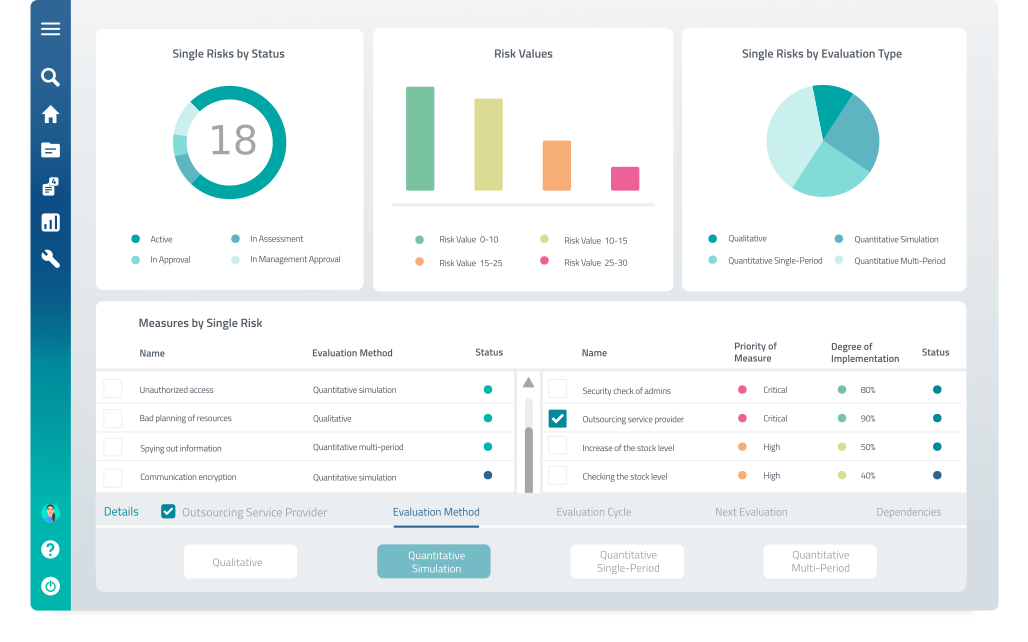
As GRC management software, GBETC GRC Management helps organisations manage risks, controls, measures, and responsibilities consistently. Important information is not locked away in separate applications or spreadsheets; instead, it can be used across different GRC activities, including assessments, evidence management, measure tracking, and reporting. This reduces manual coordination and makes it easier to manage the organisation’s risk position reliably.
GBETC GRC Management goes beyond the scope of a classic Risk Management tool. Risks are not just recorded and assessed; they are placed within the broader context of controls, responsibilities, regulatory requirements and operational processes. The result is a practical view of their real impact on the business.
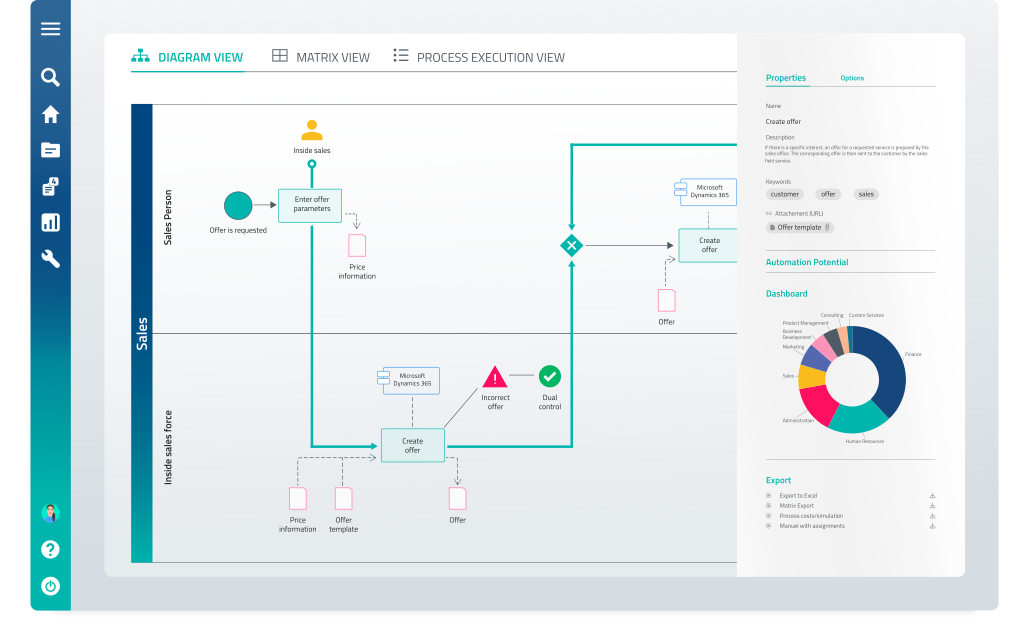
A particular advantage lies in the connection to GBTEC Process Design. It allows risks and controls to be mapped directly within the relevant process context. When processes, roles, or responsibilities change, their impact on risks and compliance requirements can be taken into account immediately. This keeps Risk Management closely tied to operational reality and prevents it from becoming detached from actual business processes.
Conclusion
Integrated Risk Management matters more than ever, because risks rarely stop at departmental boundaries. Cyber incidents, supply chain disruptions, regulatory requirements, or process failures frequently affect several GRC domains at once. Organisations that manage risks, controls, measures, and evidence separately quickly lose sight of dependencies and priorities.
Effective Risk Management does not automatically emerge from introducing additional processes or tools. What matters is bringing GRC information together so it can be used for governance, evidence management, and continuous improvement. That applies not only to large corporations, but to every organisation facing growing complexity in its business processes, supply chains, and regulatory environment.
A sensible first step towards integration is the IRM Maturity Check. It shows how well your GRC domains are already connected and which next steps will deliver the greatest value. GBETC GRC Management then helps drive this development systematically, making risks, controls, processes and responsibilities manageable within a shared framework. This creates a foundation for GRC management that not only meets external requirements, but also makes organisations more resilient and better equipped to act.
Frequently asked questions
What is Integrated Risk Management?
Integrated Risk Management (IRM) uses relevant information from areas such As Internal Control, Information Security, Business Continuity, Compliance, and Audit Management to govern risks holistically. This means risks are not considered in isolation, but across the organisation in the context of processes, controls, measures, responsibilities, and regulatory requirements.
Which organisations benefit from Integrated Risk Management?
Integrated Risk Management is particularly valuable for organisations with a complex risk landscape. This includes businesses with multiple locations, interconnected supply chains, high reliance on digital processes, or extensive regulatory obligations. The approach is especially relevant for mid-sized and large organisations, as well as for businesses in heavily regulated sectors such as financial services, energy, healthcare, or manufacturing, where risks, controls, and evidence requirements are often particularly closely linked.
What are the benefits of GRC management software?
Centralised GRC management software reduces process breaks, standardises workflows and improves the consistency of GRC information. With a tool such as GBTEC GRC Management, organisations gain a more reliable basis for risk assessments, reporting, and audit preparation, while also making it easier to meet regulatory evidence obligations in a structured, traceable way.
What role does the GBTEC Platform play in GRC management?
As part of the GBTEC Platform, GBTEC GRC Management helps organisations bring together key GRC information from areas such as Enterprise Risk, Internal Control, Information Security, Business Continuity, Compliance, and Audit, and put it to use for holistic Risk Management. Through its connection with GBTEC Process Design, risks and controls can be mapped directly within the process context, making it visible how process changes may affect risks, controls, and compliance requirements.
How can I assess the maturity of my Integrated Risk Management?
The GBTEC IRM Maturity Check lets you assess how closely Risk Management, Internal Control Systems, Information Security Management, and Business Continuity Management are already connected within your organisation. The quick self-assessment includes ten questions and provides an evaluation of your current IRM maturity level, along with recommendations for developing the integration of your GRC domains further.
GBTEC Software AG
Gesundheitscampus-Süd 23
44801 Bochum
Germany
