




Why enterprise transformation keeps failing
 02 July 2026
 Boards have never committed more to transformation, with digital spending being expected to climb towards trillions of dollars globally by 2027. AI, cloud migration, automation, and operational redesign are on every executive agenda, and the ambition is clear: to make organisations more capable, more digital, and more adaptable by reshaping processes, systems, structure, and governance in a way that holds together across every function.
And yet outcomes remain stubbornly inconsistent.
McKinsey finds that 70% of digital transformation initiatives fail to meet their objectives. Bain’s 2024 analysis of more than 900 companies found that 88% fall short of their original ambitions. Globally, the cost of failed transformation efforts is estimated at $2.3 trillion annually, according to IDC.
The issue lies less in ambition or investment than in the structural requirements of enterprise transformation and in the fact that few organisations are set up to meet them.
True enterprise transformation is not a technology deployment or a process redesign project but a comprehensive, organisation-wide change that only works when processes, systems, structures, and governance are treated as an integrated whole. When any of those dimensions is managed in isolation, the transformation itself becomes the problem.
The real culprit: fragmentation
When transformation programmes fail, the first instinct is to blame the technology choices, the consultants, or the implementation timeline. Yet, the root cause is almost always structural: organisations attempt complex, interdependent change while operating through disconnected tools, siloed teams, and fragmented data. Operational fragmentation is one of the most consistent and least-discussed transformation failure causes in large organisations.
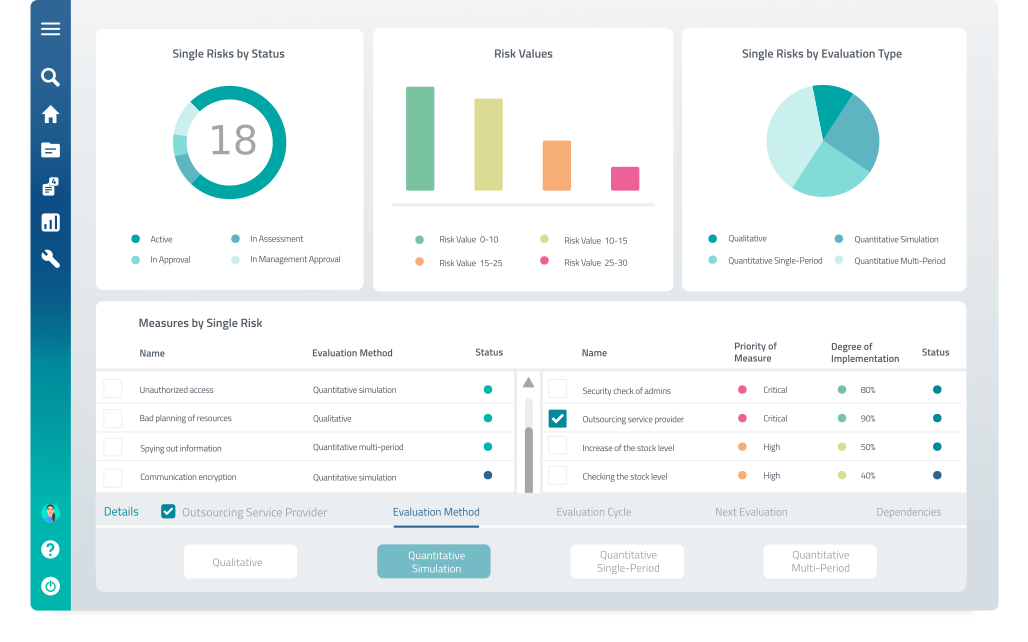
Think about how most large enterprises actually run transformation today. Business process teams redesign workflows without full visibility into the technology landscape those workflows depend on. Enterprise Architects build future-state models without an accurate view of how operations function on the ground. Risk and compliance functions assess controls separately from the processes and systems they are supposed to govern.
Each discipline has its own tooling, its own dataset, and its own version of the truth. The process-system disconnect this creates becomes an architectural flaw that compounds throughout the transformation cycle.
The result is predictable. Processes are redesigned without understanding system dependencies. Architecture decisions are made without operational context. Compliance requirements land retrospectively, creating rework, audit exposure, and delay. Regulatory changes cannot be traced to their downstream impact because no connected model exists. Complexity grows faster than transparency.
“Transformation involves technology deployment, so organisations need to understand how software applications fully support and enable defined processes. Without this connection, transformation is architecturally unsound from the start.” – Thomas Kohlenbach, Principal Consultant, GBTEC
The process-architecture gap
At the centre of this fragmentation is a specific structural problem: the disconnect between Business Process Management (BPM) and Enterprise Architecture Management (EAM). This BPM-EAM misalignment is among the most consequential and most overlooked causes of digital transformation failure.
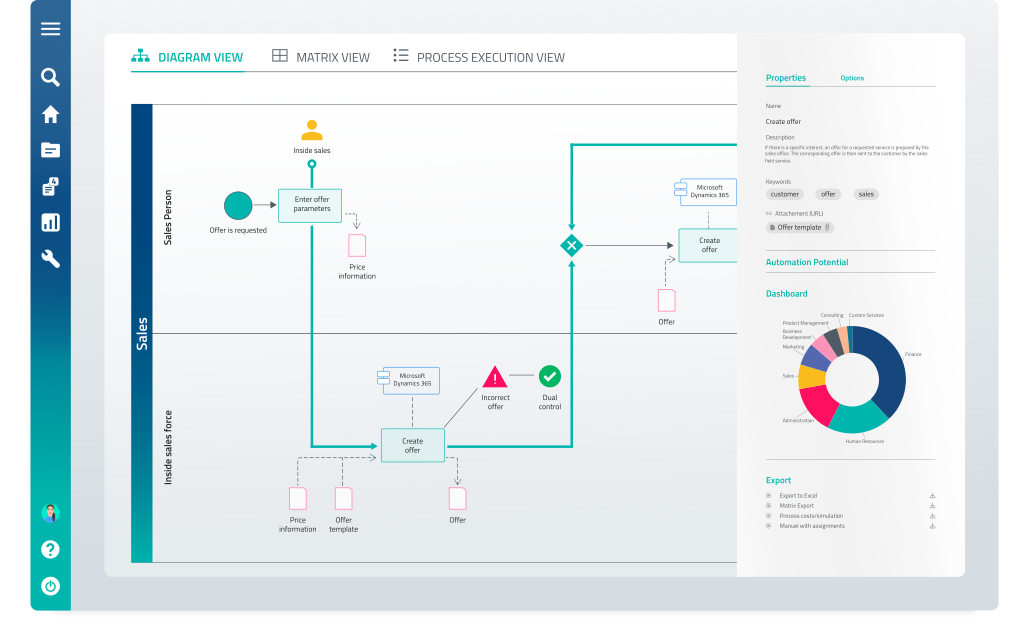
BPM documents how work actually happens – how customers are served, how products are built, and how internal functions operate. Mature BPM goes beyond documentation to enable workflow analysis, inefficiency identification, automation readiness, and the structured foundation AI deployment requires. But processes do not exist in a vacuum. Every process depends on applications, data, and infrastructure. A process initiative without visibility into those dependencies risks creating improvements that are technically unsustainable.
EAM, on the other hand, provides the strategic blueprint for an organisation’s technology landscape. It maps applications, systems, dependencies, and capabilities. When connected to operational reality, it helps organisations rationalise applications, reduce complexity, and plan transformation with confidence. But architecture models that are disconnected from live processes quickly become stale, describing the intended state of the organisation rather than the actual one.
When BPM and EAM are managed through separate tools, separate teams and separate data, neither discipline can do its job properly. The process-architecture gap that results does not stay contained – it propagates into every programme that depends on either layer being accurate.
GBTEC’s 2025 research across 600 business and operations leaders reveals how widespread this problem is:
- 46% of organisations say misalignment between process management, enterprise architecture, and systems is actively preventing their transformation efforts.
- Only 29% operate with a truly connected process environment – a single, shared, up-to-date source of truth.
- Only 49% report that their business processes fully align with and support enterprise architecture and systems.
What once seemed like an operational inconvenience has become a defining constraint on transformation performance.
Why AI is making this worse
If operational fragmentation were a manageable problem in an era of incremental change, it becomes critical in the era of AI. AI systems cannot operate effectively in undocumented, inconsistent, or fragmented environments. Automation and agentic AI require processes that are structured, governed, and clearly connected to the systems supporting them.
According to GBTEC’s 2025 research, 87% of senior business and operations leaders believe AI requires structured and governed processes to deliver value – and 78% believe AI initiatives will fail without proper process management. Yet only 17% consider their organisations highly mature in AI-enabled process operations.
The implication is significant. When AI and automation are deployed on disconnected, ungoverned processes, existing complexity scales faster than transformation outcomes. The fragmentation that was already slowing execution now compounds through automation at scale.
This is the transformation paradox: the more organisations invest in change, the more fragmentation amplifies the consequences of doing it poorly.
The governance problem nobody wants to talk about
Beneath the process-architecture gap lies a second structural failure: transformation governance that arrives too late, too narrowly scoped, and too disconnected from the operational reality it is supposed to govern.
In most large programmes, governance is applied after the design work is done, often as an approval mechanism rather than a design principle. Risk and compliance teams review outputs that were produced without their input. Controls are assessed against processes that have already been redesigned. Audit trails are constructed retrospectively rather than embedded from the outset.
The consequences are familiar to anyone who has worked on a large transformation project: late-stage compliance surprises that require significant rework, regulatory requirements that cannot be traced to their impact across the process and system landscape, and governance documentation that describes a programme as it was planned rather than as it is actually running.
Organisations that avoid this pattern embed governance into transformation design from the outset, with controls, risk ownership, and compliance requirements built into the process and architecture layer from the beginning, rather than layering them on at the end.
The path forward: A connected operating model
The answer to fragmentation is not more tools. Most enterprises already have too many of those. The answer is a fundamentally more connected approach – one in which business processes, enterprise architecture, and operational governance are managed through a shared data model rather than as isolated disciplines.
This concept is gaining significant momentum under the banner of the Digital Twin of an Organisation (DTO): a living, connected model of how an organisation actually operates across processes, systems, dependencies and governance. The broader Digital Twin market is rapidly growing, intensifying the enterprise demand for this kind of operational coherence.
The organisations building toward a DTO are not doing so by integrating more platforms. They are moving toward unified environments where the connection between process and architecture is not a workaround or an integration project but a native feature of the operating model. When BPM, EAM, and GRC share a single data model, the process–architecture gap closes structurally – because the gap itself was always an artefact of the tool separation, not an inherent feature of the problem.
What sustainable transformation actually requires
Enterprise transformation often fails when organisations attempt coordinated, organisation-wide change through tools, teams and data that are structurally disconnected. Processes are redesigned without system visibility. Architecture decisions are made without operational grounding. Governance arrives after the fact. And when AI is layered on top of this fragmentation, the consequences accelerate.
The organisations that break this pattern share a common characteristic: they treat process, architecture, and governance as a single, connected operating model – and build their transformation programmes on that foundation from the start. That shift, from fragmented disciplines to a unified operational model, is where sustainable transformation performance begins.
Frequently asked questions
Why do most transformation programmes fail to meet their objectives?
Structural fragmentation is a primary cause of digital transformation failure, often outweighing issues such as technology selection or budget. Organisations attempt complex, interdependent change while operating through disconnected tools, siloed teams, and fragmented data. Process teams redesign workflows without visibility into system dependencies. Architecture teams build future-state models without accurate operational context. Governance arrives retrospectively rather than being embedded from the start. McKinsey finds 70% of digital transformation initiatives fail to meet their objectives; Bain puts the figure at 88% across more than 900 companies. The pattern is consistent because the root cause is consistent: operational fragmentation that compounds throughout the transformation lifecycle.
What is the process-architecture gap and why does it undermine transformation?
The process-architecture gap is the structural disconnect between how an organisation’s business processes are documented and managed and how its technology landscape is governed. When BPM and EAM operate through separate tools, separate teams, and separate data, process improvements are created without visibility into system dependencies – and architecture decisions are made without accurate operational context. The gap does not stay contained: it propagates into every programme that depends on either layer being current and accurate. According to GBTEC’s 2025 research, 46% of organisations say this misalignment is actively preventing their transformation efforts.
How does misalignment between BPM and EAM impact transformation outcomes?
BPM-EAM misalignment creates a situation where neither discipline can do its job properly. Process improvements that are operationally sound may be technically unsustainable because the system dependencies were never visible. Architecture models quickly become stale because they have no live connection to operational processes. Transformation programmes built on this fragmented foundation discover their architectural constraints at implementation rather than at the design stage – triggering delays, rework, and budget overruns. Only 29% of organisations in GBTEC’s 2025 research report operating with a single, shared, up-to-date source of truth. For the other 71%, every transformation decision is made against data that cannot be fully trusted.
Why does organisational fragmentation increase transformation risk?
Fragmentation increases transformation risk because it makes the consequences of change invisible until they have already materialised. When each function operates with its own tools, its own data, and its own version of the truth, the interdependencies between process, system, and governance changes cannot be assessed before they are triggered. Regulatory changes cannot be traced to their downstream impact. System modifications create process failures that were not anticipated. Automation initiatives land on foundations that were never designed to support them. AI compounds this further: deploying AI and automation on fragmented, ungoverned processes can amplify the consequences of underlying fragmentation.
Why is governance often applied too late in transformation programmes?
In most large programmes, transformation governance is treated as a review and approval mechanism rather than a design input. Risk and compliance functions are engaged after processes have already been redesigned and systems have already been selected. Controls are assessed against outputs that were produced without governance context. The result is late-stage compliance surprises, retrospectively constructed audit trails, and governance documentation that describes the programme as planned rather than as it is actually running. The organisations that avoid this pattern embed controls and compliance requirements into the process and architecture layer from the beginning – making governance a structural feature of the operating model rather than an external check applied at the end.
GBTEC Software AG
Gesundheitscampus-Süd 23
44801 Bochum
Germany
