




Your business is changing faster than your understanding of it
Most organisations believe they understand their processes. Yet ask three people how a critical process works and you will often get three different answers. Not because anyone is wrong. Because the organisation is learning more slowly than it is changing.
 21 October 2026
Choose a business-critical process such as order to cash, customer onboarding, or incident escalation. Ask the person who owns it, the person who performs it, and the person responsible for assuring or auditing it to explain how it works.
Their answers may differ considerably, not because any of them are necessarily wrong, but because they are describing different versions of the same process: the process as designed, performed, and controlled. In many organisations, these versions gradually diverge without a reliable mechanism for identifying where or why.
This is the "Learning Gap": the distance between how fast an organisation changes and how fast its understanding of itself updates. Businesses change continuously through new regulations, supplier issues, system changes, reorganisations, and AI adoption. Process knowledge, however, is often updated only during major initiatives such as an ERP migration, transformation programme, or certification audit.
The result is an organisational Learning Gap that widens as operational reality continues to change faster than the organisation's formal understanding of it. Some organisations, however, learn to close this gap. We call them Process Superlearners™; we'll come back to what sets them apart later in this piece.
The Learning Gap continues to widen
The pace of operational change is increasing. A regulatory change can require controls to be reassessed within months. A supplier disruption can alter established workflows within days. An acquisition or reorganisation can redistribute responsibilities across functions and systems. AI can introduce entirely new ways of executing individual activities. Each change potentially invalidates part of what the organisation previously understood about how work gets done.
The mechanisms used to maintain that understanding have not always evolved at the same pace. Many organisations still update process documentation on a project cycle: significant effort is invested during a transformation or audit, followed by a period in which operational reality continues to evolve while the documented view changes more slowly. Documentation may be accurate when published but becomes progressively less representative of day-to-day operations. This process knowledge decay eventually undermines confidence in whether the documented operating model still reflects reality.
Fragmented knowledge makes the problem harder to detect
The Learning Gap is compounded when the information required to understand an operation is distributed across multiple systems and teams.
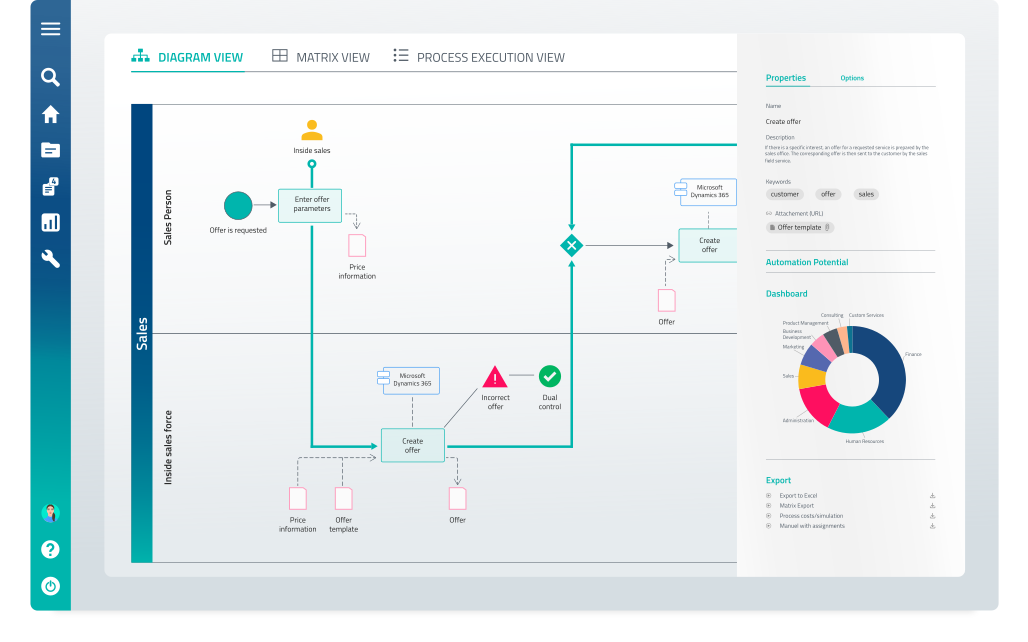
Process models may sit in one platform, application architecture in another, risks and controls in a separate system, organisational responsibilities elsewhere, and execution data in operational applications. Each source can be individually correct while still presenting only part of the picture. When process knowledge is fragmented across teams, inconsistencies become difficult to identify. An outdated document may be relatively visible, but several independently maintained sources can contain conflicting versions of the truth without making clear which information is no longer accurate.
This helps explain why process documentation is rarely fully up to date in large organisations. The problem is not necessarily a lack of effort, but that documentation is maintained separately from many of the changes that affect it.
The distinction between continuous process knowledge and periodic documentation therefore matters. A periodic documentation exercise attempts to capture the organisation at a particular point in time, while continuous process knowledge aims to maintain an organisational view that can evolve as the underlying business changes.
How quickly does the organisation update what it knows?
One useful diagnostic question is to consider a business-critical process and ask when it was last reviewed, what triggered that review, and how closely the documented version reflects the work being performed today.
The answers reveal more than whether the documentation is accurate. If a process was last examined during a system implementation, operational teams rarely use the documented model, or different functions maintain conflicting versions, the organisation has a learning problem rather than simply a documentation problem. The relevant question is how quickly it can detect change, understand the implications, and incorporate that knowledge into its operations. That capability is learning velocity.
The Learning Gap creates a structural risk for transformation
Transformation programmes depend on an accurate understanding of the organisation they intend to change.
When that understanding is incomplete or outdated, the programme may design a future state against assumptions that no longer reflect the current state. As implementation progresses, further operational changes can widen the gap again. This can help explain why transformation programmes struggle to deliver or sustain their intended outcomes, even when governance and sponsorship are strong.
A transformation may successfully introduce a new process, application, or organisational structure, but the operating environment continues to evolve afterwards. Teams adapt the prescribed way of working, exceptions emerge, responsibilities shift, and systems are configured differently from the original design. If these changes are not reflected in the organisation’s process knowledge, the new operating model begins to diverge from reality.
Verification is therefore an important part of organisational learning. Updating documentation and completing training demonstrates that a change has been communicated. It does not demonstrate that the change has been adopted in practice. Without a mechanism for verifying execution, organisations cannot reliably distinguish between an approved process and an adopted process.
The same gap will constrain enterprise AI
The Learning Gap becomes particularly important as organisations move from isolated AI experiments towards operational use cases.
AI systems can analyse information, identify patterns, and support decisions at scale, but their usefulness depends on the quality and structure of the organisational context available to them. In many enterprises, teams cannot describe authoritatively how a process operates, which activities are formal controls, where exceptions occur, which applications support individual steps, or who owns particular decisions.
This creates an enterprise legibility gap for AI: the technology may be capable of interpreting complex information, but the organisation has not made its own operations sufficiently explicit and connected for that information to be interpreted reliably. This helps explain why AI cannot reliably improve a process it cannot describe. Providing AI with an incomplete or outdated representation does not resolve the Learning Gap. It may simply allow incorrect assumptions to be processed faster and at a greater scale.
An AI-ready operating model therefore requires more than access to data. It depends on current, structured knowledge of processes, systems, roles, controls, and dependencies, together with mechanisms for keeping that knowledge aligned with operational change.
Learning velocity makes the gap measurable
The Learning Gap becomes actionable when organisations can measure how quickly their understanding catches up with change. Learning velocity is the elapsed time between a business change occurring and that change being understood, documented, governed, reflected in day-to-day work, and verified.
For organisations considering how to measure learning velocity, a practical starting point is to select a recent change – such as a regulatory requirement, system migration, organisational restructuring, or significant process change – and examine four stages:
- Detected. How long did it take for the relevant stakeholders to recognise that the change had occurred?
- Understood. How long did it take to determine which processes, systems, roles, risks, or controls were affected?
- Embedded. How long did it take for documentation, controls, responsibilities, and training to reflect the new situation?
- Verified. How long did it take to confirm that the intended change had been adopted in day-to-day operations?
The time taken to move through these stages provides a practical measure of an organisation’s learning velocity. In many organisations, the greatest delay is not necessarily in detecting change. It occurs between understanding the implications of a change, embedding them across multiple organisational views, and verifying that the new way of working has become operational reality.
A Learning Velocity Check makes those delays visible. It also provides a more useful starting point for improvement than asking whether process documentation is simply “up to date”.
Closing the Learning Gap requires a continuous capability
More frequent documentation projects can improve process information at a particular moment, but they do not create a continuous learning capability. If operational knowledge is reconciled only periodically, the gap begins to reopen as soon as the business changes again.
Closing it requires organisational self-understanding to become a continuous capability.
That means connecting process, architecture, organisational risk, control, and operational perspectives closely enough so that changes can be detected, understood, embedded, and verified with less delay. It also requires clear ownership of the knowledge itself: who is responsible for identifying a change, assessing its implications, and ensuring that the organisation’s operating model continues to reflect reality.
Human judgement remains essential throughout this process. People still need to interpret context, resolve conflicting information, approve changes, and determine whether documented processes correspond to what happens in practice. The objective is therefore not effortless automation. It is a more reliable mechanism for keeping organisational knowledge aligned with operational reality.
Organisations that develop this capability can update their understanding at a pace closer to that of operational change. They become better at learning from change and incorporating that knowledge into subsequent decisions.
We call these organisations Process Superlearners™.
Is your organisation learning as fast as it changes?
The Process Superlearner whitepaper shows what the gap is costing you and gives you six principles to start measuring today.
Frequently asked questions
What is the Learning Gap?
The Learning Gap describes the distance between how fast an organisation changes and how fast its understanding of itself updates. It grows when processes, systems, controls, and working practices change continuously, while the knowledge used to describe them is refreshed only during periodic projects.
Why does process documentation become outdated so quickly?
Process documentation often follows a project cycle, with major updates during migrations, audits, or transformation programmes and limited maintenance between them. Operational changes continue during that interval, so documentation gradually diverges from how work is performed. Fragmented ownership across teams and tools can accelerate this process knowledge decay.
How do you measure learning velocity?
Measure the elapsed time from a real business change to four outcomes: the change is detected, its operational impact is understood, documentation and controls are updated, and the new way of working is verified in practice. Tracking all four stages shows where organisational learning slows down or stops.
Why do transformation programmes fail despite good planning?
A programme may be well planned but still rely on an incomplete or outdated view of the current state. Processes can also continue to change while the programme is being delivered. If the resulting changes are not continuously understood, embedded, and verified, the intended future state can begin to drift soon after go-live.
Why is the Learning Gap becoming a bottleneck for AI adoption?
AI-supported process analysis and automation depend on reliable descriptions of how work is performed, including controls, exceptions, systems, and decision ownership. When that knowledge is outdated or fragmented, an otherwise capable model works with an incomplete operational picture and may produce inaccurate recommendations or overlook important dependencies.
GBTEC Software AG
Gesundheitscampus-Süd 23
44801 Bochum
Germany
