




Unification vs. integration: Why the distinction is critical for enterprise transformation
 02 July 2026
 Enterprise transformation fails at high rates not because organisations lack ambition, investment or technology, but because their operating models are too fragmented to support change at scale. BPM, EAM, and GRC are often managed as disconnected disciplines, each with its own tools, data structures, governance logic, and version of operational reality. The result is an unstable foundation for transformation – even when the individual systems involved are sophisticated.
This is why many organisations turn to operating model transformation: a fundamental restructuring of how processes, systems, roles, and governance are organised so that change can be executed faster, more consistently, and at greater scale. For most organisations, that restructuring begins with a familiar move: integration. This means connecting the systems, building the APIs, and creating the data feeds.
But this response, while common, misunderstands the nature of the problem. Integration can create connectivity but does not necessarily create coherence. And the risks this distinction creates are ones that many IT and transformation leaders only discover too late.
What integration actually delivers
Most large enterprises today operate through integrated environments. BPM platforms exchange data with architecture tools through APIs, middleware, or synchronisation layers. On the surface, this looks like connectivity. In practice, it creates what might be called connectivity without coherence.
When separate systems are integrated, each platform still maintains its own data model, its own governance logic, and its own operational perspective. Processes, systems and controls may reference one another, but they are not inherently part of the same operational structure. Every new integration creates a new dependency rather than simplifying the model. And as more systems are connected, the integration layer itself becomes a source of fragility rather than a foundation for scale.
Over time, this produces a predictable set of problems:
- Synchronisation gaps: data in one system goes stale before it updates another, and decisions are made on outdated views.
- Inconsistent definitions: the same process or application is described differently across tools, creating reconciliation overhead that consumes time and introduces errors.
- Manual maintenance burden: someone must always manage the integration layer – patching, updating, and troubleshooting – and that overhead scales with complexity.
- Multiple versions of truth: teams in different functions are working from different datasets at any given moment, without visibility into which version is current.
- Integration failures at scale: as complexity grows, the integration layer becomes a single point of failure across the transformation programme.
Integration works well when systems serve fundamentally different purposes, for instance by connecting ERP and CRM or by linking finance systems to HR platforms. BPM and EAM do not represent separate operational domains in the same way. They describe different dimensions of the same operational reality. Connecting them through integration is a structural compromise that leaves the core problem unresolved: process-system dependencies remain invisible until they fail.
What a unified operating model looks like
A unified operating model operates differently at its foundation. Rather than separate systems connected through integrations, processes, systems, capabilities, and governance, objects exist within one connected data model. The consequences of this distinction are concrete and operationally significant.
When an Enterprise Architect changes a system dependency in the EAM layer, process owners are immediately aware of the implications for every process that depends on that system – not because an integration fires a notification, but because the data is shared by design. When a process owner redesigns a workflow in BPM, the architectural impact is visible in real time, and any new risks or control implications surface automatically within the same environment.
When a compliance officer identifies a regulatory change, it can be traced immediately to the specific processes and IT systems it affects, rather than being discovered through a manual cross-reference exercise across three different platforms. When a transformation programme is being planned, its full impact across processes, systems, and compliance obligations can be assessed before a single change is made in the real world.
This end-to-end transparency across process, architecture, and governance simultaneously is what makes a connected operating model qualitatively different from an integrated one. Decisions improve because the data supporting them is consistent, transformation risk decreases because dependencies are visible before changes are made, and manual reconciliation overhead disappears.
the data supporting them is consistent, transformation risk decreases because dependencies are visible before changes are made and manual reconciliation overhead disappears because there is nothing to reconcile.
Why native unification is different from integrated unification
A growing number of enterprise vendors now offer what they describe as unified platforms. In practice, many of these are portfolios assembled through acquisitions or integrations, where separate product architectures persist underneath a shared interface. Organisations still manage multiple governance models, synchronisation layers, and data structures, even if the front-end experience looks consolidated.
The distinction matters because operational visibility depends on data consistency. When the underlying data is not genuinely shared, the limitations of integration reappear in more subtle forms: slightly different definitions, subtly misaligned records, or governance frameworks that do not propagate automatically across disciplines.
Native unification avoids these compromises entirely. There is one data model across all disciplines, with no synchronisation lag and no reconciliation overhead. Changes propagate in real time across processes, architecture, and governance simultaneously. And because there is a single governance framework, a single interface, and a single vendor relationship, the operational model does not accumulate the fragility that comes from managing multiple integrated systems over time.
This is also the environment in which AI and automation can be deployed with confidence. AI agents require process models that are accurate, current and architecturally grounded. In an integrated environment, that accuracy cannot be guaranteed between synchronisation cycles. In a natively unified environment, it is a structural property of the data model.
Three forces accelerating the shift
The case for unified transformation environments is not new in principle. What has changed is the convergence of forces turning it from a long-term optimisation goal into an urgent strategic priority.
- AI is exposing the cost of fragmentation. Automation and agentic AI require structured, governed processes connected to their supporting systems. Organisations are discovering that their biggest barrier to AI adoption is not the technology itself, but the lack of operational clarity underneath it. Deploying AI on top of disconnected, ungoverned processes does not produce faster transformation – it produces faster chaos.
- Operational complexity is outpacing visibility. Large enterprises commonly operate five or more disconnected tools across process management, architecture, governance and operational analysis. As complexity increases through factors like cloud migration, platform consolidation, cybersecurity requirements, or global operations, the limitations of disconnected tooling become progressively more costly. Transformation initiatives slow because teams cannot assess which systems support which processes, where dependencies exist, or what downstream impact a proposed change will create.
- Enterprise leadership now requires operational intelligence. The roles of the CIO and Enterprise Architect have expanded significantly beyond infrastructure management. Technology leadership now means the ability to model change, understand dependencies, evaluate risk, and guide transformation decisions with confidence – and that requires simultaneous visibility across process and architecture, in real time. Fragmented operating models structurally cannot provide this.
The path to a Digital Twin of an Organisation
The Digital Twin of an Organisation (DTO) is not a futuristic concept. It is the natural endpoint of mature, connected BPM and EAM practice – and the architectural capability that makes scenario analysis, impact simulation and continuous transformation governance possible at enterprise scale.
When processes are documented and governed, when they are connected to the systems that support them, when risks and controls are mapped across both layers, and when all of this is maintained in a single, living data model, the result is functionally a Digital Twin. According to Grand View Research, the global DTO market is projected to reach $328 billion by 2033, at a CAGR of 31.1% from 2026 to 2033.
A genuine Digital Twin Architecture cannot be assembled through integration alone. The continuously connected view of business processes and the technology landscape supporting them, with governance embedded across both layers rather than stitched together through middleware, is a property of native unification, not of separate systems connected through integration.
Organisations that build toward a DTO through integration are building on a foundation that will require replacement as scale increases. Those that build on a natively unified data model are building toward it structurally.
What sustainable operating model transformation actually requires
The distinction between integration and unification is not a technical preference – it has direct consequences for how reliably an organisation can execute transformation at scale. Integrated environments create connectivity between systems that remain structurally separate. Unified environments create a shared operational model in which process, architecture, and governance are inherently consistent.
The organisations closing the gap between transformation ambition and transformation performance share a common characteristic: they have moved beyond integrating their disciplines toward genuinely unifying them. That shift from coordinated silos to a connected operating model built on shared data is where the compounding costs of fragmentation stop and where sustainable transformation capability begins.
How GBTEC supports unified transformation
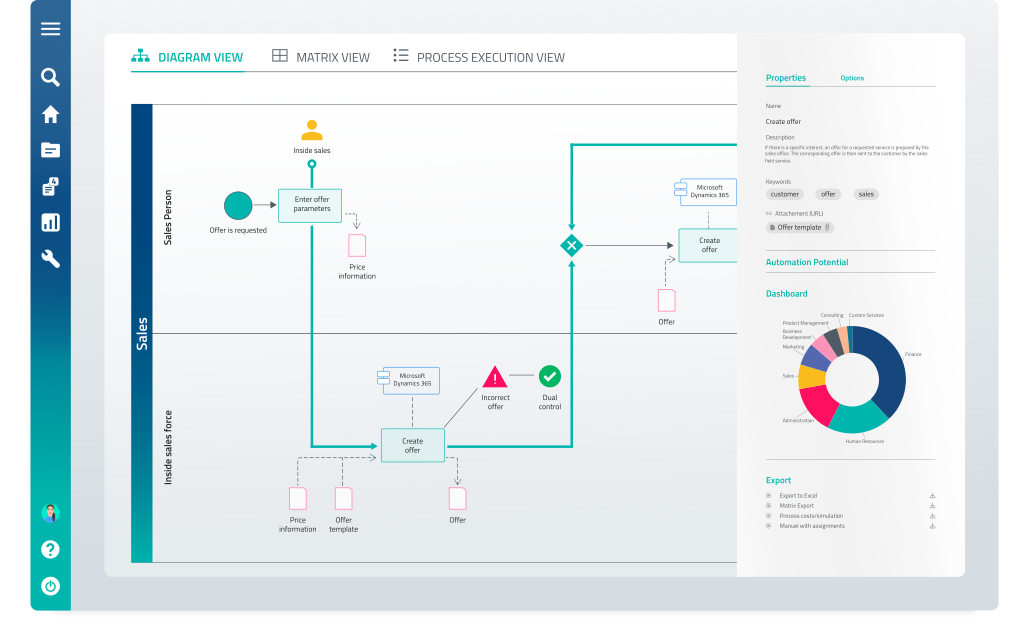
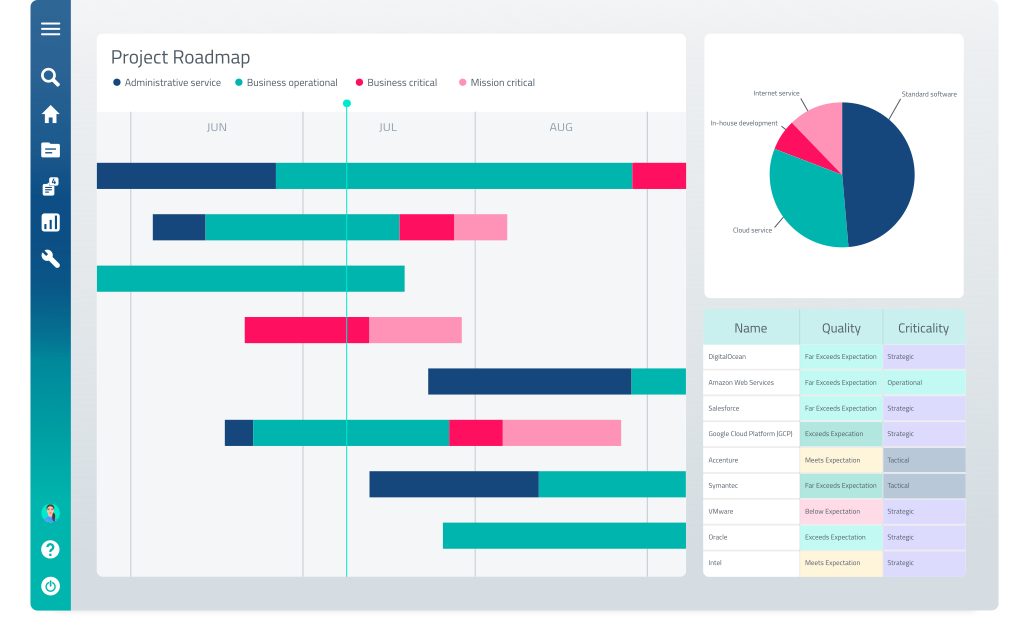
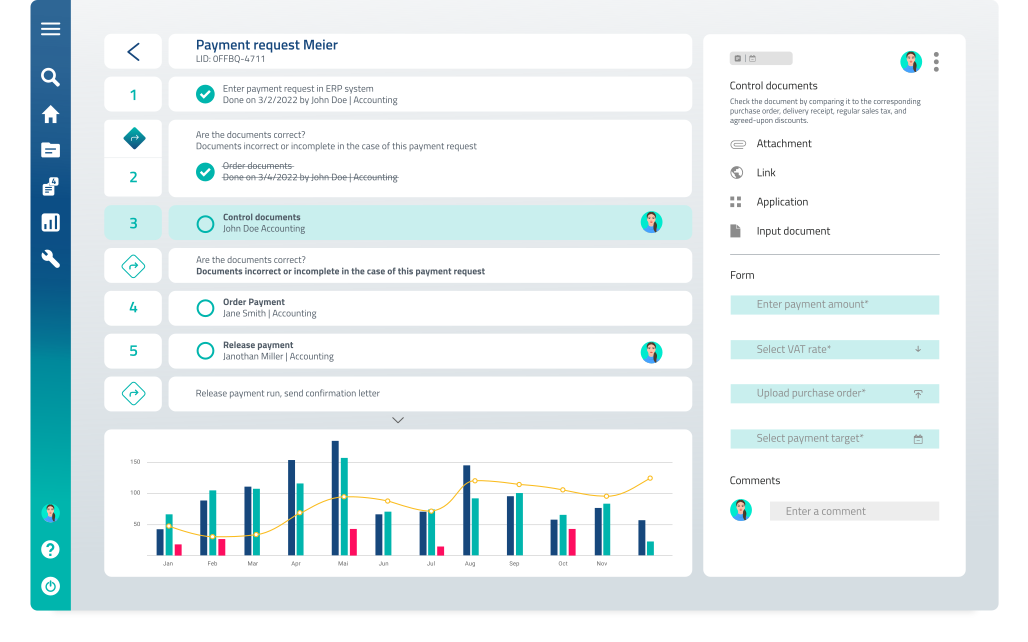
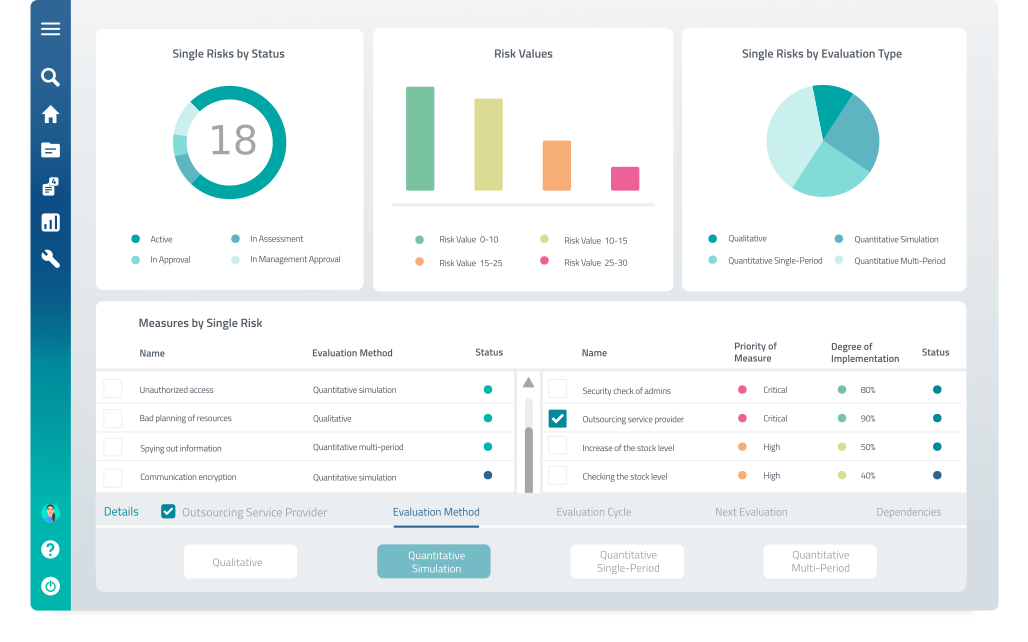
provides a practical foundation for unified operating model transformation. By bringing Business Process Management, Enterprise Architecture Management, Governance, Risk, and Compliance, Process Mining and Workflow Automation together in one platform, GBTEC enables organisations to connect processes, IT landscapes, risks, controls, and transformation initiatives in a shared operational context.
This matters because sustainable transformation requires more than isolated optimisation within individual departments. Process owners need visibility into the systems that support their workflows. Enterprise Architects need to understand the business impact of IT decisions. Governance and compliance teams need to trace regulatory obligations across both process and technology layers.
Explore how the GBTEC Platform helps organisations unify BPM, EAM, and GRC to build the foundation for sustainable enterprise transformation.
Frequently asked questions
Why is integration not enough for enterprise transformation?
Integration connects systems without changing their underlying structure. Each platform continues to maintain its own data model, its own governance logic, and its own version of operational reality. Over time, this produces synchronisation gaps, inconsistent definitions across tools, manual reconciliation overhead, and integration failures as complexity scales. For systems that describe different dimensions of the same operational reality – as BPM and EAM do – integration is a structural compromise. It leaves the core problem unresolved: process-system dependencies that are invisible until they fail and a fragmented data landscape that prevents confident transformation decisions.
What is the difference between integrated and unified transformation environments?
In an integrated environment, separate systems exchange data through APIs, middleware, or synchronisation layers. Each system retains its own data model and governance logic; connectivity is achieved through external linkages rather than shared structure. In a unified environment, processes, systems, capabilities and governance objects exist within one connected data model by design. Changes propagate automatically across all disciplines simultaneously. There is no synchronisation lag, no reconciliation overhead, and no risk of one system holding a more current view than another. The operational consequence is significant: a unified environment provides genuine end-to-end transparency across process, architecture, and governance in real time, while an integrated environment approximates this through periodic synchronisation.
Why do BPM and EAM need to operate on a shared data model?
BPM and EAM describe different dimensions of the same operational reality – how work is done and what technology supports it. When they operate on separate data models, process improvements are designed without visibility into system dependencies, and architecture decisions are made without accurate operational context. The process-system dependencies that sit between these two disciplines become invisible until a process change breaks a system, or a system change disrupts a process. A shared data model eliminates this gap structurally: changes in either layer are immediately visible in the other, impact assessments can be made before changes are implemented, and the organisation always has a single, consistent view of how its processes and technology relate.
How does native unification reduce transformation risk?
Native unification reduces transformation risk by making the consequences of change visible before changes are made. When processes, architecture and governance share a single data model, the downstream impact of any proposed change – to a process, a system, a control, or a compliance requirement – can be traced across the full operating model in real time. This eliminates the category of risks that integration cannot address: the risks that arise at the boundaries between systems, in the gaps between synchronisation cycles and in the inconsistencies between different tools’ versions of operational reality. For AI and automation specifically, native unification also provides the accurate, current, and architecturally grounded process models that AI agents require to operate reliably.
What architectural capabilities are required for a Digital Twin of an Organisation?
A genuine Digital Twin of an Organisation requires four interconnected architectural capabilities. First, a single, continuously maintained data model that spans business processes, IT systems, and governance structures, without synchronisation gaps or reconciliation overhead. Second, real-time propagation of change across all three disciplines simultaneously, so that the Digital Twin always reflects current operational reality rather than a periodically updated snapshot. Third, governance is embedded structurally across both the process and architecture layers so that regulatory changes can be traced to their impact and compliance obligations are visible alongside operational data. Fourth, queryability at any level of abstraction – from technical system detail to executive summary – so that the Digital Twin supports both architectural decision-making and strategic transformation planning. These capabilities are properties of native unification, not of separate systems connected through integration.
GBTEC Software AG
Gesundheitscampus-Süd 23
44801 Bochum
Germany
