





Deepfake fraud in business – when a video call becomes a multi-million-dollar risk
 10 June 2026
 When a video call costs millions
In 2024, a finance employee at a company in Hong Kong transferred US$25.6 million to fraudsters. The payment was made after a video call with what appeared to be the CFO and several other senior executives. Only later did the company discover that every one of those executives had been an AI-generated deepfake. The employee was the only real person in the meeting and approved the transfer in good faith.
When Hong Kong police confirmed the incident, it attracted international attention. More importantly, it highlighted how real the threat of deepfake fraud has become.
According to the Entrust Cybersecurity Institute, attempted deepfake scams increased by more than 3,000% between 2023 and 2024. The financial consequences can be significant. A study conducted by Regula and Sapio Research found that 92% of affected organisations suffered losses, with the average loss amounting to approximately US$450,000 per incident.
The growing number of cases shows that deepfake fraud has become a relevant risk for many organisations. The challenge lies in preventing a convincing deception from turning into a costly incident. In many cases, the damage is not caused by deception alone, but by weaknesses in controls and verification procedures that allow the attack to succeed.
What is deepfake fraud in a business context?
Deepfake fraud refers to the deliberate use of AI-generated voices, images, or videos to imitate real people with striking realism. The aim is to persuade employees to take actions they would not normally carry out.
Deepfake Scam scenarios involving video calls are particularly dangerous, since attackers pose as trusted executives, business partners, or colleagues. In many cases, familiar forms of fraud such as Business Email Compromise are combined with deepfake technology. The result is a highly credible attack that can deceive even experienced employees.
This shows that deepfake fraud is about far more than cybersecurity. In many cases, the real weaknesses lie in missing verification procedures, insufficient controls, and limited risk awareness. These are precisely the areas addressed by governance, risk, and compliance.
Why deepfake fraud is not just an IT issue
Cases like this often lead companies to focus on technical solutions first. These may include detection software or additional authentication steps. While such measures can reduce risk, they are not enough on their own if the organisational framework is weak. Deepfake attacks exploit human trust and existing process weaknesses.
In the widely cited Hong Kong case, the core issue was not merely that an employee was deceived by a deepfake. More importantly, the organisation lacked adequate safeguards to independently validate a transaction of that magnitude. The video call effectively became the sole basis for authorisation, with no mandatory callback procedure, no consistently enforced four-eyes review, and no multi-layer approval process.
This highlights the broader challenge: deepfake-enabled fraud is most effective when sophisticated deception exploits weaknesses in organisational controls. The primary vulnerability therefore lies not in the technology itself, but in the absence of clear, well-enforced verification procedures. As a result, preventing deepfake fraud is as much a governance and process issue as it is a technological one.
Deepfake risks are still largely absent from internal control frameworks
Despite the rapid rise in deepfake-enabled fraud, many organisations have yet to recognise it as a distinct risk category within their internal control and risk management framework.
This often manifests itself in several ways:
- Unclear accountability for managing deepfake-related risks
- A lack of structured risk assessments
- Weak or non-existent links between identified risks and corresponding controls
- Insufficiently documented awareness and training initiatives
- Limited evidence that existing safeguards are effective against deepfake-enabled attacks
These shortcomings are not surprising. Deepfake fraud has emerged as a significant threat in a relatively short period of time, while many governance and control frameworks were developed before such risks became a realistic concern. As a result, deepfake-related risks are frequently addressed only indirectly, if at all, and are often not systematically incorporated into risk registers, control activities, or operational processes.
Effective mitigation requires more than isolated security measures. Organisations are far better positioned to limit the impact of deepfake attacks when risks are formally identified, linked to appropriate controls, and embedded within existing governance and business processes.
Mapping deepfake risks: three steps to greater security
Step 1: identify and assess deepfake risks
The starting point is to recognise deepfake fraud as a distinct operational risk within the organisation’s risk management framework. Once identified, the risk should be assessed in terms of both its likelihood and its potential impact. Relevant business processes, risk owners, and areas of responsibility should also be clearly documented. Functions with elevated exposure typically include finance, treasury, procurement, human resources, and IT support teams.
A key consideration at this stage is the level of specificity applied to the risk assessment. Rather than treating deepfake fraud as a broad AI-related risk, organisations should examine realistic attack scenarios and the harm they could cause. This allows for a more accurate assessment of financial and operational exposure and provides a solid foundation for designing effective control measures.
Step 2: map risks to controls
Once the risks have been identified, the next step is to determine which controls can reduce the likelihood and impact of a deepfake attack. The objective is to ensure that a successful deception attempt does not automatically lead to financial loss or other significant consequences.
Common governance controls include:
- Mandatory callback procedures for payment instructions
- Multi-stage approval workflows for transactions above defined thresholds
- Four-eyes reviews for critical decisions
- Independent verification of requests to change master data
- Documented approval procedures for sensitive transactions
Controls are most effective when they are embedded in everyday business processes and applied consistently. Even if an attacker succeeds in creating a convincing deepfake, well-designed controls can prevent the attack from progressing to actual harm.
Step 3: monitor controls and verify their effectiveness
Controls are only effective if they continue to work as intended over time. Regular reviews help organisations determine whether existing safeguards remain fit for purpose as threats evolve. Clear ownership, consistent monitoring, and documented evidence of control performance all contribute to this assessment. The same applies to training and awareness activities, which should be evaluated regularly to determine whether employees can recognise and respond to deepfake attacks more effectively.
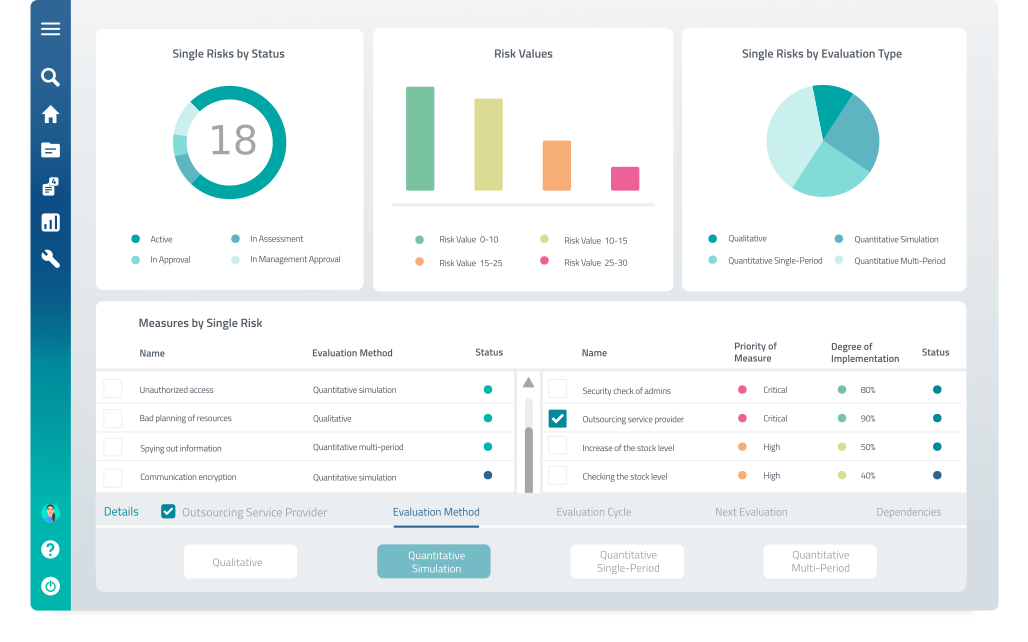
With GBTEC Enterprise Risk and GBTEC Internal Control, organisations can manage risks, controls, and mitigation measures on an integrated GRC platform. This creates a clear link between identified risks and the controls designed to address them, while providing transparent and auditable documentation of all relevant safeguards.
Conclusion
Deepfake fraud is no longer solely an IT or cybersecurity concern. Whether an attack results in significant harm depends largely on the strength of an organisation’s governance, controls, and decision-making processes.
Technology plays an important role in prevention, but it is only one part of the solution. Effective protection requires a combination of well-designed processes, robust controls, and ongoing employee awareness. Together, these measures help companies detect fraudulent requests, prevent unauthorised actions, and reduce the impact of successful attacks.
Organisations that address deepfake risks proactively and integrate them into their existing risk and control frameworks will be better prepared for both current and future threats.
Frequently asked questions
How does deepfake fraud work in a video call?
Attackers use artificial intelligence to generate convincing real-time video and audio impersonations of executives or other trusted individuals. During a video call, they may request payments, changes to master data, or other sensitive actions, relying on the perceived legitimacy of the interaction.
How can organisations prevent deepfake attacks?
The strongest defence combines clear approval procedures, independent verification, effective governance controls, and regular employee training. While technical detection tools can provide additional support, they do not replace these measures.
Which processes are most vulnerable to deepfake fraud?
Processes that involve financial transactions, identity verification, or changes to sensitive information are particularly vulnerable. Common examples include payment approvals, procurement activities, IT helpdesk requests, and master data maintenance.
Which governance controls help prevent deepfake fraud?
Effective controls include callback procedures, the four-eyes principle, multi-stage approval workflows, independent identity verification, and clearly defined escalation procedures.
How dangerous are deepfake video calls for organisations?
Deepfake video calls are among the most convincing forms of AI-enabled fraud because they combine visual and audio manipulation with social engineering techniques. In the absence of effective controls, they can lead to significant financial and operational losses.
How should organisations assess deepfake fraud as a risk?
Deepfake fraud should be treated as a distinct operational risk. The assessment should consider the likelihood of an attack, the potential impact, the affected business processes, and the controls in place to mitigate the risk.
Why is deepfake fraud not just an IT issue?
Deepfake fraud relies on advanced technology, but its success is usually determined by human and organisational factors. Weak verification procedures, inadequate controls, and unclear responsibilities can all make an organisation more vulnerable to attack.
How does the four-eyes principle protect against deepfake attacks?
The four-eyes principle ensures that critical decisions are reviewed by a second person before action is taken. By introducing an independent check, it reduces the likelihood that a fraudulent request will be accepted on the basis of a single call or video meeting.
GBTEC Software AG
Gesundheitscampus-Süd 23
44801 Bochum
Germany
