




Multi-period simulation and risk stressing – how organisations learn to think about risk over time
 27 May 2026
 The limits of static risk assessment
Many organisations take comfort in a risk matrix that appears stable. But that apparent stability can be misleading. Risks often build gradually, reinforce one another or take years before their full impact becomes clear. The real question is not simply where things stand today, but which risks may emerge over the next few years and what happens if several adverse factors occur at the same time.
This is exactly where scenario analysis becomes essential. By systematically exploring possible future developments and their impact on risk exposure, it creates the basis for reliable risk forecasting and a sound forward-looking risk assessment. It makes it easier to understand how risks may change under different conditions and what the implications of each scenario may be.
Why a traditional risk matrix is no longer enough
A traditional risk matrix is useful for prioritising and documenting risks. But it often falls short when it comes to strategic decision-making, since it mainly reflects the current situation. It does not adequately capture long-term developments, interdependencies between risks or the consequences of exceptional scenarios.
This is where many organisations start to run into difficulty. Without scenario analysis, multi-period simulation and risk stressing, early warning signs are often recognised too late, interdependencies are overlooked, and extreme but plausible developments are not examined in a structured way. At the same time, regulatory requirements are placing greater emphasis on forward-looking analysis. In that context, a static view of risk is becoming harder to justify.
How multi-period simulation reveals long-term risks
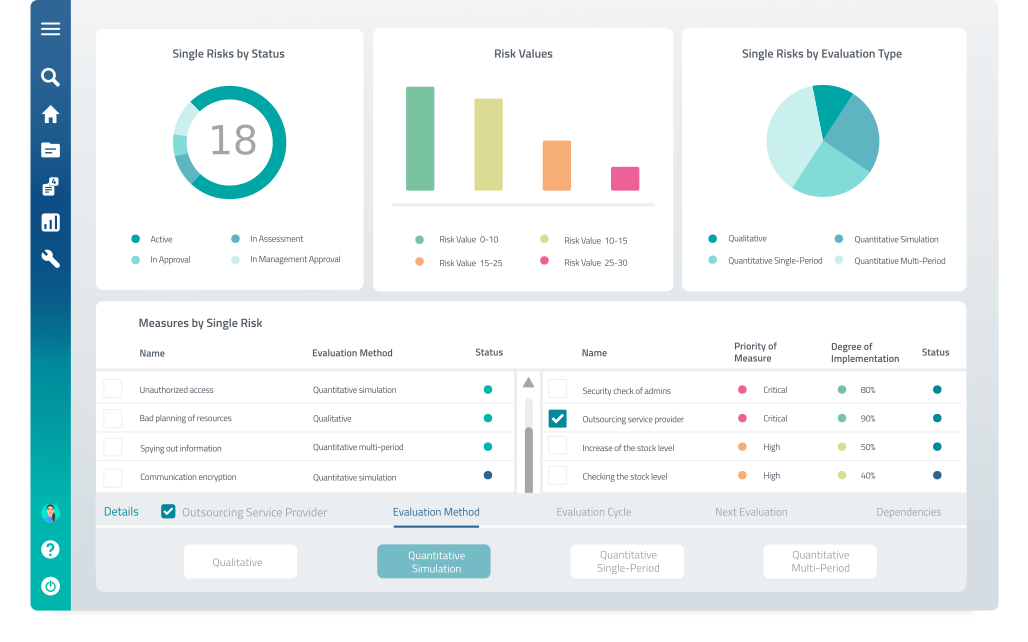
Multi-period simulation gives organisations a clearer view of how an aggregated risk portfolio may evolve over one to five years by modelling changes in likelihood, financial impact and mitigation costs in a transparent way.
Simulations make it easier to identify which risks are becoming more significant, when mitigation is needed and how financial impact can build over several years. This matters particularly in cases where risks build gradually, as static assessments often fail to show how quickly the need to respond is increasing.
This approach improves not only the quality of risk modelling, but planning as well. It gives organisations a more reliable basis for risk forecasting, helps them set budgets more realistically and allows them to prioritise measures at an earlier stage.
Extreme scenarios and the role of stress testing
While multi-period simulation looks at how risks may evolve over time, risk stressing examines potential extreme scenarios. By deliberately intensifying an individual risk, for example by assuming a higher loss or certainty of occurrence, it enables targeted stress testing of particularly critical factors.
This is especially valuable when organisations need to assess how resilient they would be in exceptional situations. Risk stressing shows which individual risks could have a disproportionate impact, where critical thresholds may be reached and which vulnerabilities are likely to matter most in a crisis.
Rare but high-impact events are particularly easy to underestimate in day-to-day business. These may include sudden regulatory intervention, supply chain disruption or major technological change. A structured stress test helps examine such scenarios systematically and assess their potential impact in concrete terms.
Scenario analysis as a foundation for better decisions
Multi-period simulation and risk stressing serve different purposes, but they are most useful when combined. As part of scenario analysis, they provide a clearer view of the overall risk position and a stronger basis for strategic decision-making.
Credible assumptions about possible developments and their impact make it easier to assess different courses of action on a well-informed basis. This reveals which measures are likely to remain effective under different conditions and where additional safeguards may be needed.
GBTEC GRC Management brings these capabilities together within a structured framework. It supports scenario analysis, multi-period simulation and stress testing in an integrated environment. Scenarios and their implications can be documented and analysed consistently, making them usable across the organisation. This creates a sound foundation for evaluating future risks in a transparent and consistent way.
Conclusion
Organisations that look at risk only in its current state are missing part of the picture. As part of scenario analysis, multi-period simulation and risk stressing add a forward-looking dimension to traditional risk assessment. Multi-period simulation shows how risks may develop over time, while risk stressing highlights the potential impact of exceptional scenarios. Together, the two methods provide a strong basis for better-informed decisions, more realistic planning and more effective risk management.
Simulate risks with GBTEC GRC Management – before they become reality
Frequently asked questions
What is scenario analysis?
Scenario analysis is a risk management method used to systematically examine possible future developments. It helps organisations understand how risks may change under different conditions.
Why is a traditional risk matrix not enough?
Because it only offers a limited view of risk at a given point in time. It often fails to show how risks evolve, how they interact and what their impact could be.
How does multi-period simulation support risk forecasting?
By modelling risks and their financial impact over several years. This makes it easier to identify trends, uncertainties, mitigation effects and potential costs.
What is the difference between scenario analysis and a stress test?
Scenario analysis explores multiple possible future scenarios. A stress test deliberately intensifies individual risks to assess how resilient an organisation would be under extreme conditions.
How many scenarios does an organisation really need?
The number itself is less important than the relevance of the scenarios. In many cases, a few clearly defined scenarios are sufficient if they cover the most important uncertainties and interdependencies.
How do multi-period simulation and risk stressing complement each other?
Multi-period simulation shows how risks evolve over time. Risk stressing additionally reveals how sensitive the portfolio is to extreme stress conditions. Together, they provide a more complete picture of future risk exposure.
GBTEC Software AG
Gesundheitscampus-Süd 23
44801 Bochum
Germany
