




How NIS2 structures security and strengthens organisational resilience
 20 May 2026
 Regulation between uncertainty and defence
NIS2 is often associated with uncertainty, additional pressure and potential sanctions. Those reactions are understandable – but they fall short. Beyond its obligations, the directive provides a clear framework to systematically design security.
NIS2 acknowledges a reality that already exists: digital dependencies are omnipresent. Security failures are no longer local events. Responsibility therefore needs to be organised in a structured way.
NIS2 as a framework for clarity, transparency and security culture
NIS2 can be understood as a transparency and maturity framework that requires organisations to make security decisions visible. The focus is on documented decisions, structured processes and clearly assigned responsibilities.
The requirements go far beyond mere compliance evidence. Risks must be systematically assessed, prioritised and translated into concrete measures. What matters is not only which measures are implemented but also how decisions are made. Traceable documentation creates clarity, comparability and a reliable foundation for consistent decision-making, even under time pressure.
This benefits not only organisations but also executives. In case of an incident, what matters is not just the outcome but also the documented decision-making path. Step by step, this builds a higher level of maturity in dealing with cyber risks.
Incident management without improvisation
The clearly defined reporting obligations make one thing clear: security must not be improvised. Early warning, reporting and disclosure require prepared processes, clear roles and structured information flows.
In the context of NIS2 incident reporting, this means that workflows must not be improvised and aligned in advance. Mature organisations use these requirements to sharpen their processes – both in emergencies and in daily operations. If processes are only created once an incident occurs, this leads to delays and uncertainty.
Supply chains as responsibility
NIS2 firmly anchors responsibility for ICT third parties with the affected entities. Trust alone is no longer sufficient. Systematic assessments, continuous monitoring and realistic contingency plans are required.
Security thus becomes a shared responsibility across the entire value chain. Structured integration of third parties increases transparency regarding external dependencies and strengthens organisational resilience.
Supervision as a reflection of maturity
The expanded NIS2 oversight mechanisms are often perceived as a threat. However, in organisations with clear structures, a different picture emerges: audits are conducted on the basis of traceable information.
Where decisions are documented and processes are clearly defined, a factual basis for dialogue with supervisory authorities is created. Where traceability is lacking, pressure increases during inspections. Transparent structures reduce this uncertainty.
From reaction to design
The greatest value of NIS2 lies in the opportunity to actively design security. Organisations gain clarity about risks, responsibilities and measures.
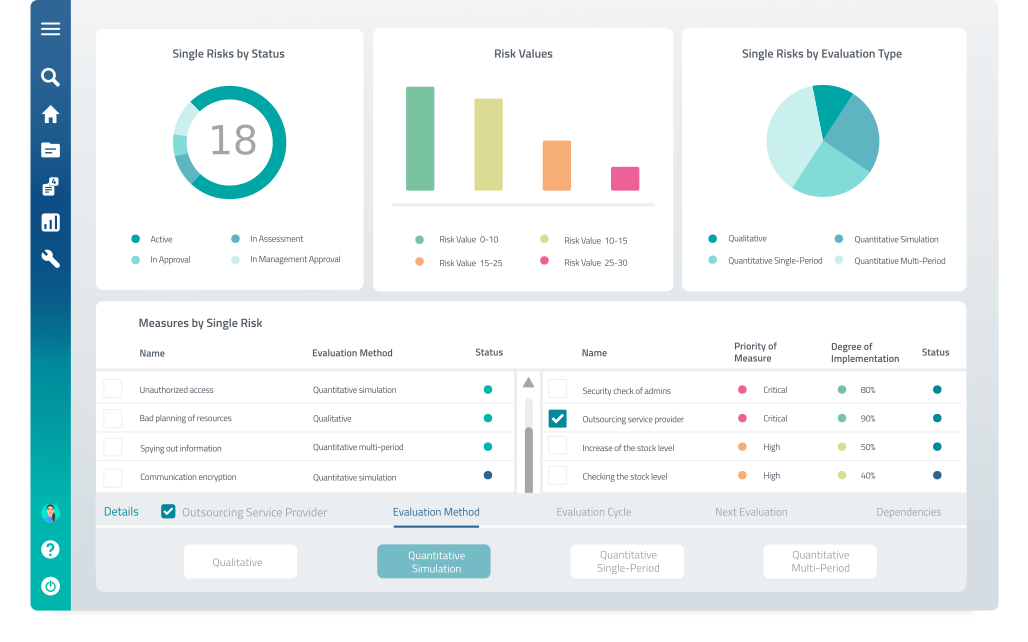
Digital GRC approaches like GBTEC GRC Management create this transparency at a systemic level. Risks, incidents and evidence are recorded and linked in a structured way. Through this, they enable governance instead of replacing it.
Conclusion
NIS2 is a regulatory framework for responsible security. Organisations that work in a structured way with transparency, processes and responsibilities gain clarity in dealing with risks. This enables a shift from uncertainty to a robust security culture and sustainable resilience.
Find out how GBTEC GRC Management can help you with your NIS2 implementation
Frequently asked questions
How does NIS2 help organisations with structuring security?
By defining clear requirements for processes, documentation and responsibilities, NIS2 creates a framework in which risks can be systematically managed.
What does transparency mean under NIS2?
In the context of NIS2, transparency means that decisions, measures and risks are documented in a way that is traceable and auditable.
How does incident management work under NIS2?
Incident management is based on defined processes, clear roles and fixed reporting deadlines for early warning, notification and reporting.
How does NIS2 influence security culture?
The directive promotes structured decision-making processes and clear responsibilities, fostering a sustainable security culture.
What does supervision expect under NIS2?
Traceable decisions, documented processes and a clear structure for handling risks and incidents.
GBTEC Software AG
Gesundheitscampus-Süd 23
44801 Bochum
Germany
