




Less guesswork, more confidence – how risk simulation improves decision-making
 27 May 2026
 Risk management is a leadership responsibility
Many organisations aim to introduce risk simulations but often limit them to isolated analyses or one-off calculations. In practice, risk simulation only delivers its full value when embedded within a holistic risk management framework.
Risk simulation uses quantitative methods to evaluate uncertainty and model potential outcomes. When applied effectively, it gives management a clearer view of risks, makes different scenarios easier to compare, and supports more confident, well-informed decisions.
As regulatory pressure increases and business environments become more unpredictable, qualitative assessments alone no longer provide enough insight. Risk simulation turns uncertainty into something measurable, helping executives compare scenarios more effectively and allocate budgets and mitigation measures with greater precision.
What executives actually need
Senior management does not need abstract ratings. They need a clear basis for decisions. Traditional risk reports often rely on categories such as “high” or “medium”, but those labels do little to answer the questions that matter most.
Executives want to understand the financial implications of risks, identify realistic scenarios, and assess how risks could affect the organisation in practice. This is where risk simulation demonstrates its real value. It aggregates individual risks, considers dependencies, and presents results as monetary values and probabilities. As a result, decisions no longer rely on intuition alone but on transparent and evidence-based scenarios.
While traditional approaches often take weeks to deliver meaningful insights, integrated simulation tools such as GBTEC GRC Management provide results far more quickly. Automated simulations and ready-to-use evaluations replace manual Excel models, aggregation processes, and lengthy coordination cycles.
Stop speculating, start simulating: a quick guide to Monte-Carlo-Simulation
The Monte-Carlo method of simulation calculates thousands of possible future scenarios and derives probability distributions from them. This allows organisations to model uncertainty realistically and make informed assessments of potential losses.
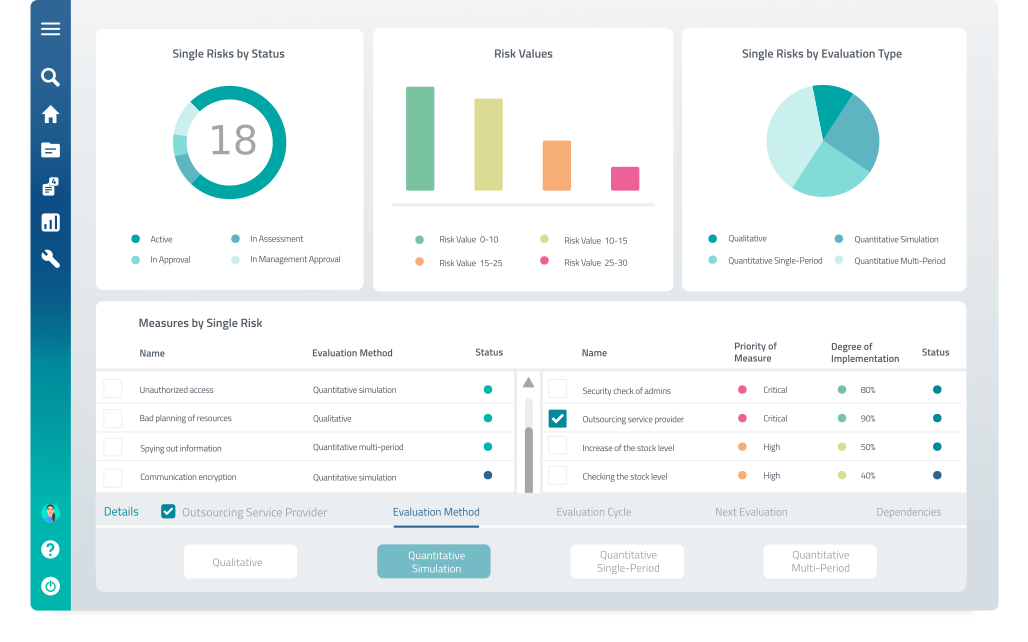
However, Monte-Carlo-Simulation only becomes truly effective when integrated into risk management processes. GBTEC GRC Management embeds this methodology directly into the risk management platform, enabling companies to simulate individual risks, aggregate risk portfolios, and test the effectiveness of mitigation measures in a targeted way.
GBTEC GRC Management also supports multi-period simulations for short- and medium-term planning within a single integrated solution. All process steps work seamlessly together, eliminating workflow disruptions and the need for additional tools.
Successfully introducing risk simulation into the organisation
When introducing risk simulation into an organisation, the key question is simple: where does it add real value to decision-making? Only by answering this can risk simulation become an effective tool for corporate management.
The next step is to establish reliable structures. This means clearly defining responsibilities and roles for risk simulation and ensuring that data is collected and assessed in a consistent way. With this foundation, organisations can develop a sound scenario analysis that delivers meaningful and consistent results.
The true value of simulation becomes clear once it is fully integrated into existing risk management processes. It should become an integral part of reporting, risk reviews, and management decisions. Transparent communication, targeted training, and clearly presented results all play a crucial role in building acceptance and embedding risk simulation across the organisation over the long term.
Why risk simulation initiatives often fail
Many organisations fail to realise the full value of risk simulation. In most cases, the issue is not the technology itself, but the insufficient integration of simulation insights into risk management processes and decision-making structures. Responsibilities are often unclear, data is not provided consistently, and simulations are perceived as an additional administrative burden.
Another common challenge is poor communication of results. If management cannot interpret simulation outcomes correctly, the insights quickly lose their value. The success of risk simulation therefore depends heavily on clear processes, automated workflows, and understandable reporting.
Conclusion
Risk simulation is far more than an analytical tool. It is a key management instrument that enables organisations to manage uncertainty proactively, make informed decisions, and implement effective measures.
Businesses that introduce risk simulation benefit from faster decision-making, reduced manual effort, and greater transparency across their overall risk exposure. Combining clearly defined risk management processes with integrated simulations and automated workflows allows businesses not only to document risks, but to manage them actively and identify emerging developments at an early stage.
Simulate risks with GBTEC GRC Management – before they become reality
Frequently asked questions
How can organisations successfully implement risk simulation?
Organisations need a clear strategic objective, defined roles within the risk simulation framework, and structured risk management processes. It is essential to standardise data flows and firmly integrate simulations into reporting and decision-making processes.
What is risk simulation used for?
Risk simulation helps organisations analyse uncertainty systematically and make decisions based on quantified risks. It reveals complex interdependencies and creates transparency regarding the overall risk exposure.
Which decisions can be supported by a Monte-Carlo approach to simulation?
Monte-Carlo-Simulation provides a reliable basis for strategic decisions, investment planning, and the prioritisation of mitigation measures. Applying the Monte-Carlo technique of simulation helps businesses understand which scenarios are most likely and how they may affect overall risk exposure.
Where does risk simulation create value for organisations?
Risk simulation enables better-informed decisions on risk exposure, the use of mitigation budgets, and the planning of risk responses. Although many organisations still rely on manual data handling and fragmented systems, a more effective approach is to feed data into simulations automatically, consistently, and as part of a seamless process.
How should simulation results be communicated so management can use them effectively?
Simulation results should be presented visually and linked clearly to their financial impact. Well-defined scenarios, probabilities, and loss distributions help make complex information easier to understand and support better decision-making.
How can simulation be integrated into existing risk management processes?
Risk simulation should sit at the heart of risk assessment, reporting, and strategic decision-making. Businesses gain the greatest value from Monte-Carlo risk simulations when they become a natural part of everyday risk management rather than a standalone exercise.
GBTEC Software AG
Gesundheitscampus-Süd 23
44801 Bochum
Germany
