




When familiar voices deceive: How Voice Cloning puts your internal controls to the test
 15 June 2026
 When trust becomes a liability
In departments such as accounting, procurement, and the IT service desk, countless requests are processed every day. Some involve urgent payments, others require changes to supplier master data or password resets. Most of these requests are entirely legitimate. However, a single manipulated request can be enough to cause significant financial damage.
Fraudsters are increasingly targeting these everyday situations. AI-powered Voice Cloning makes it possible to create highly convincing imitations of real people’s voices and make them say virtually anything. In many cases, just a few seconds of publicly available audio is enough to do so. As a result, seemingly legitimate instructions and approvals can be used to persuade individuals to take actions they would otherwise question or refuse.
A study published by business.com in 2024 highlights the growing concern among organisations. 32 percent of executives surveyed said they lacked confidence in their teams’ ability to identify Deepfake fraud attempts.1Yet many organisations still rely on their employees to detect fraudulent requests. If a deception goes unnoticed, there are often no controls in place to prevent the resulting damage. In such cases, a single successful manipulation can be enough to cause significant financial loss.
Why Voice Cloning is more than an IT problem
From a governance, risk, and compliance perspective, AI Voice Cloning Fraud is particularly concerning because it directly impacts critical business processes. Common targets include activities with significant financial, regulatory, or operational implications.
The risk becomes especially acute when apparently legitimate instructions trigger an action with significant consequences. Without safeguards such as secondary approvals, callback procedures, or other independent verification steps, a single successful deception can quickly lead to substantial losses. The real challenge is therefore not only detecting a Deepfake, but ensuring that critical workflows remain protected even when a fraudulent request appears genuine.
A 2024 fraud case in Hong Kong illustrates how real this threat has become. A finance employee took part in a video call with what appeared to be senior executives. In reality, the participants were AI-generated Deepfakes using cloned voices to impersonate company leaders. They convinced him to authorise transfers of approximately USD 25 million.2 The incident shows that Deepfake Fraud can directly affect critical business processes and lead to costly mistakes.
Where AI Voice Cloning Fraud poses the greatest risk
Deepfake Fraud is rarely random. In most cases, fraudsters use targeted social engineering techniques to exploit processes in which urgency, confidentiality, or personal communication play an important role. The risk is particularly high when verbal instructions are accepted without independent verification.
Examples of high-risk scenarios include:
- Payment approvals by phone, voicemail, or video call
- Changes to master data based on phone instructions
- Purchasing requests that require immediate action
- Password resets or identity approvals in the IT help desk
- Instructions that bypass normal approval processes
CEO Fraud Deepfakes create additional pressure. Employees believe they are speaking to a senior leader who demands confidentiality and expects immediate action. These attacks are especially effective when individuals are under time pressure, new to their role, or unable to verify an instruction through an independent channel.
Many organisations underestimate how convincing an AI Voice Scam can be. But Voice Cloning Detection alone is not enough. Effective controls must continue to protect critical processes even when a fraudulent instruction appears credible and the deception is not recognised immediately.
Controls reduce the risk of Voice Cloning Fraud
An effective Internal Control System does not need to identify every fraud attempt immediately. What matters is that critical actions cannot be triggered by a single instruction.
For example, payments above a defined threshold should always require a second approval. Changes to supplier or bank account information should be confirmed using previously verified contact details or a separate communication channel before any action is taken. Similarly, password resets in the IT help desk should be based on a structured identity check rather than a verbal request alone.
Controls like these significantly reduce the risk of AI Voice Cloning Fraud. They add safeguards that continue to work even when a Voice Deepfake makes a request seem authentic. Security authorities recommend exactly this approach: unusual or urgent requests should not be acted on immediately, but confirmed through an independent channel first.
Turning controls into effective protection
Many organisations already have controls in place to reduce fraud risk. The challenge is often determining whether those controls are applied consistently and deliver the intended level of protection. Risk managers should therefore ask three key questions:
- Which risks are covered by our existing controls?
- Which measures are consistently applied in day-to-day operations?
- Where do gaps still exist?
When dealing with AI Voice Cloning Fraud, defining controls is only the first step. Organisations need a clear understanding of who is responsible for controls, which risks they mitigate, and whether they are effective in practice. Without that transparency, weaknesses can easily go unnoticed.
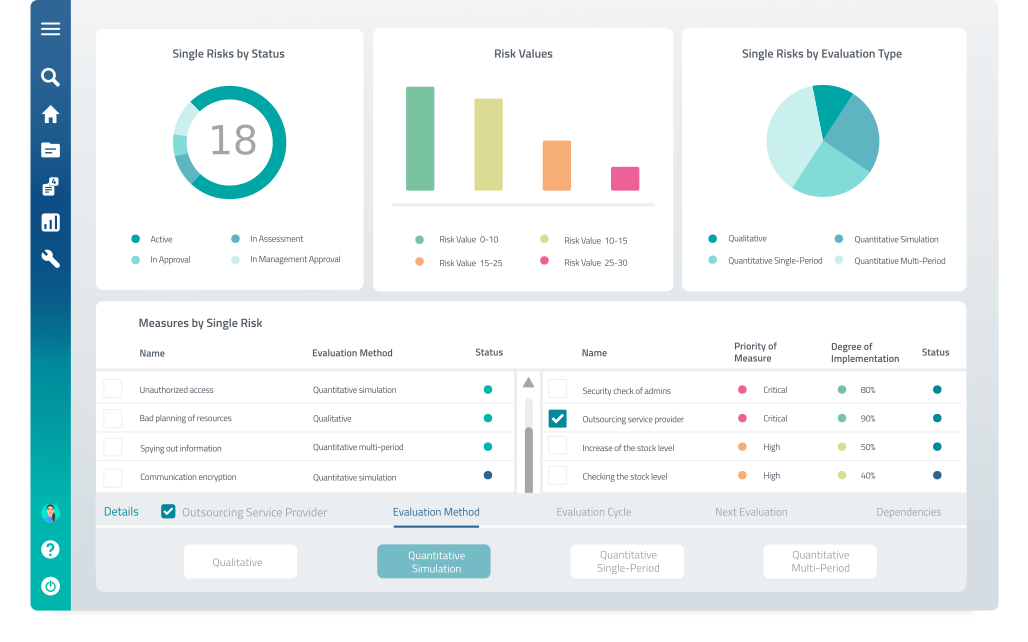
This is why control management is essential. With GBTEC Internal Control, risks, controls, and responsibilities can be linked in a structured way, making it easier to identify gaps and strengthen the control environment where it matters most. This is particularly important when addressing AI Voice Fraud and other forms of Deepfake-enabled deception.
Conclusion
The growing threat posed by Voice Cloning makes one thing clear: a familiar voice is no longer a reliable way to verify someone’s identity. Therefore, controls must continue to provide protection even when manipulated instructions appear genuine. Callback procedures, additional approvals, and structured identity checks provide important safeguards against AI Voice Cloning Fraud. To remain effective, even the strongest protective measures must be applied consistently and reviewed on a regular basis.
Companies that systematically connect risks, controls, and responsibilities become more resilient to Voice Cloning, AI Voice Fraud, and other forms of Deepfake Fraud.
Reduce Your Deepfake Risk with GBTEC GRC Management
1Source: https://www.business.com/articles/deepfake-threats-study/
Frequently asked questions
How does Voice Cloning Fraud work?
Attackers use artificial intelligence to create a highly convincing copy of a real person’s voice. Short audio clips from public sources such as interviews, podcasts, or social media videos are often enough to do so. The cloned voice is then used to pressure employees into taking actions that can have financial, operational, or security-related consequences.
How can you recognise a Voice Cloning attack?
Voice Cloning is often difficult to detect. Common warning signs include unusual urgency, demands for secrecy, evasive answers, or attempts to bypass established procedures. Even when these signs are missed, controls such as callback procedures, secondary approvals, and identity checks should prevent fraudulent instructions from resulting in harmful actions.
What signs suggest a voice may be AI-generated?
There are no universally reliable acoustic indicators. Some AI Voice Scam attempts may sound slightly unnatural in their intonation, response timing, or conversational flow. But modern systems are often so realistic that those clues are missing, or only noticed too late. That is why Deepfake Voice Detection should never be treated as a sufficient safeguard on its own. Critical instructions should always be verified independently.
Why is Voice Cloning more dangerous than traditional Vishing (“Voice Phishing”)?
Voice Cloning attacks are designed to exploit trust and social pressure. Fraudsters imitate the voice of an executive, colleague, or business partner, making their instructions sound more credible and more likely to be followed.
How is Voice Cloning used in payment fraud?
Voice Cloning is often used to fake urgent payment requests, trigger changes to bank or supplier details, or obtain approvals outside normal processes. Workflows are especially vulnerable when people place too much trust in the credibility of a familiar voice.
Which controls are most effective against Deepfake Fraud?
Safeguards include multi-step approval processes for payments, callback procedures using verified contact details, additional checks for changes to supplier or bank account information, and structured identity verification. Their effectiveness depends on consistent application and robust enforcement.
Do existing processes need to be completely redesigned?
No. Usually there is no need to overhaul workflows from scratch. In many cases it is enough to strengthen existing processes with additional control steps.
GBTEC Software AG
Gesundheitscampus-Süd 23
44801 Bochum
Germany
