




Moving beyond qualitative assessment – why risk quantification can’t wait any longer
 27 May 2026
 A common pattern across businesses
Risk managers are all too familiar with this situation: a comprehensive Excel spreadsheet, carefully maintained and filled with colour-coded indicators and probability ratings. The results appear in quarterly reports, are presented to the board, but rarely lead to meaningful action. Not because the risks are ignored, but because the format does not provide a reliable basis for decision-making.
This illustrates the limitations of qualitative risk assessment. It offers snapshots rather than scenarios. Risks are described, but their actual impact remains vague. Most importantly, it cannot present an organisation’s overall risk exposure in a way that executives can directly use for strategic decisions.
The difference between qualitative and quantitative risk assessment
Qualitative risk assessment typically classifies risks as “high”, “medium” or “low” and often relies on experience, expert judgement and discussion rather than on measurable data. This approach emerged in a business environment where risks were easier to monitor, and business models were more stable.
The weaknesses of traditional qualitative methods are well known. Individual risks cannot be meaningfully combined through aggregation, leaving boards and supervisory bodies without a reliable view of the organisation’s total risk exposure. Decisions are based on assumptions and experience rather than statistically grounded scenarios. In addition, organisations often allocate mitigation budgets without reference to their actual risk exposure, which can lead to inefficient use of resources.
Today’s risk landscape is more complex, interconnected, and dynamic than ever before. As a result, qualitative approaches are increasingly insufficient. Regulatory requirements such as IDW PS 340 also increase the demand for transparent and reliable risk models.
Quantitative risk assessment addresses these challenges directly by evaluating risks using statistical methods, probability distributions, and scenario-based techniques such as Monte-Carlo-Simulation. This makes risks comparable, measurable, and quantifiable in financial terms, creating a clearer foundation for decision-making.
Meeting complexity with quantification
Quantitative risk assessment — particularly when supported by Monte-Carlo-Simulation — changes the way risk management works at a fundamental level. Risks are translated into monetary values and represented through loss distributions and quantile-based measures.
By running thousands of calculations, the simulation provides a statistically sound estimate of what could happen under different conditions. For example, it can show the probability that losses exceed a certain threshold or remain within a defined range.
These insights directly support strategic decisions. Organisations can define risk appetite more effectively, plan mitigation budgets with greater precision, and evaluate options with confidence.
Once risks are quantified, they can be compared and prioritised in a transparent and consistent manner.
From individual risks to the bigger picture
A major advantage of the quantitative approach is its ability to assess risks in relation to one another. By combining individual risks and reflecting their interdependencies, it provides a more precise picture of a company’s overall risk exposure.
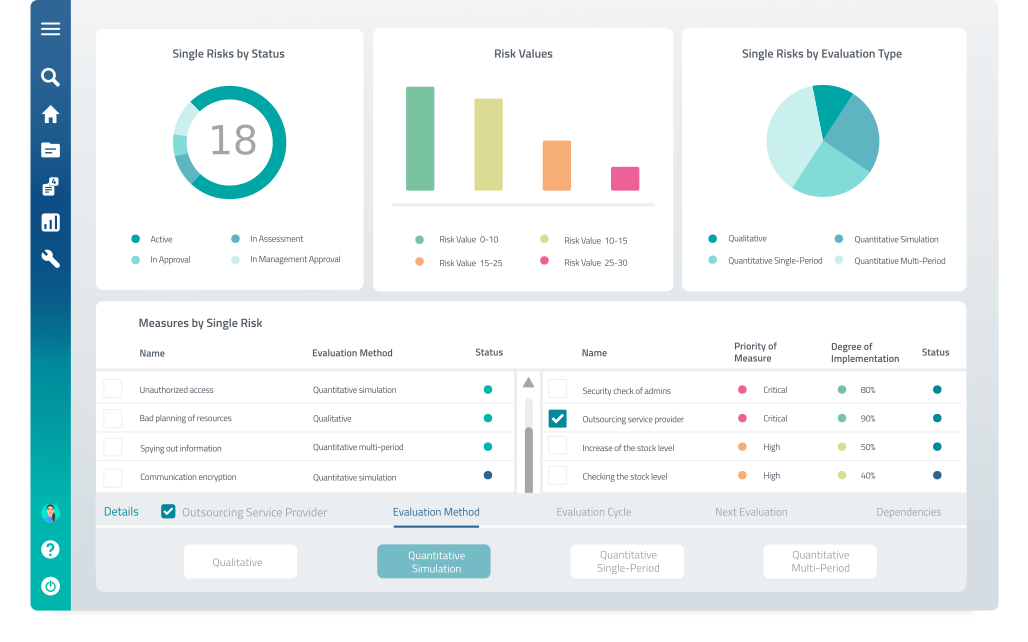
GBTEC GRC Management supports on-demand simulations with minimal preparation.
Risk managers can:
- apply different probability distributions
- model dependencies between risks
- compare measures before and after implementation
This provides a holistic view of risk across the organisation. As a result, decisions improve, budgets can be allocated more efficiently, and risk awareness increases.
Conclusion
As business risks become more complex, qualitative assessments are no longer enough. Organisations that quantify risk instead of relying on intuition or heat maps create a stronger basis for governance, communication, and prioritisation.
The result is greater transparency, more targeted mitigation, and a clearer integration of risk into corporate decision-making. GBTEC GRC Management drives this shift forward by making simulations accessible and placing quantitative risk assessment at the centre of modern GRC management.
Simulate risks with GBTEC GRC Management – before they become reality
Frequently asked questions
What is the difference between qualitative and quantitative risk assessment?
Qualitative risk assessment uses categories such as “high” or “low”, heat maps, or Excel spreadsheets to evaluate risks. Quantitative risk assessment uses probabilities, financial values, and statistical models.
Why is qualitative risk assessment no longer sufficient today?
It is no longer sufficient because it does not support meaningful aggregation, produce credible scenarios, or provide a reliable view of risk across the organisation.
Which methods are used for risk quantification?
Key methods include Monte-Carlo-Simulations, scenario simulations, statistical distribution models, and approaches such as Cyber-Risk-Quantification.
How does Monte-Carlo-Simulation work?
Monte-Carlo-Simulation runs thousands of scenarios with different input parameters to estimate the probability distribution of possible outcomes.
How can risks be assessed without historical data?
Even without historical data, risks can be assessed by combining expert judgement with statistical assumptions and translating them into scenario simulations.
Which KPIs are useful in quantitative risk assessment?
Useful KPIs include expected loss, Value at Risk (VaR), quantile measures, and aggregated risk positions.
GBTEC Software AG
Gesundheitscampus-Süd 23
44801 Bochum
Germany
