




Mastering Meter to Cash Transformation Using AI-Driven Process Standardization
 19 January 2026
 Any homeowner will know the dread of hearing a dripping pipe. Plumbing is one of those jobs that usually requires an expert to fix, because knowing there is something leaking somewhere in the walls, floor, or roof is a nightmare, and finding a way to fix it is even worse. There’s a similar sense of frustration for many organizations in the utilities industry when they look closely at their revenue pipelines. Like an aging plumbing system, there are leaks, drops in the flow, and unnecessary bottlenecks in the meter-to-cash systems they use. They’re the kinds of breakdowns that would justify the employment of a plumber in any home. The do-it-yourself approach of patching the visible leaks isn’t enough; there needs to be a professional eye brought to bear on the whole problem. AI-driven process standardization is that key to effectively unclogging the flow of revenue and removing those leaks for good.
Legacy pipelines and modern pressures
With rapidly growing populations and both the increasing density of our major centres and their continual expansion, traditional meter-to-cash systems in the utilities industry are no longer fit for purpose. The combination of increased complexity and legacy processes creates inconsistencies and breakdowns that leak revenue at an alarming rate.
This is why digital transformation in utilities has become a strategic imperative, not simply as a technology upgrade, but as a fundamental redesign of how data, processes, and customer interactions are managed across the meter-to-cash lifecycle.
Most systems will have been patched over the years with new technological solutions to meet the growing demands. However, this creates a web of unconnected tools that don’t always cooperate. Solutions like smart meters provide an abundance of information, often to legacy frameworks that don’t have the capacity to manage it effectively. Often, the data provided needs to be manually assessed, if at all, slowing the flow of information to a crawl. Where those reports go unreviewed, errors can creep in easily, which cascade into billing disputes, driving customers to call on more staff resources to investigate and rectify the problems. Those processes all take time, meaning payments are delayed and customer satisfaction plummets. When the meter-to-cash pipeline isn’t operating effectively, the entire enterprise is impacted through reduced revenue, efficiency, and customer trust.
Mixed solutions need consistent management
While disparate systems and tools can create numerous breakdowns, much of the problem lies in the inconsistency with which they’re deployed and managed. Many utilities find they cover broad regions, leading to widespread teams and knowledge disparities. When much of the intervention in breakdowns is manually driven, it means there will be a variety of response timeframes and approaches. Both the raw data being produced by meters and the exceptions created by billing errors or queries will go through different prioritization and routing depending on the systems and people involved. Oftentimes it’s that inconsistency that diminishes the effectiveness of the digital tools available. Specialised knowledge in some teams may not be shared, and best-practices may be hidden within off-the-books processes utilized by some, who don’t realize others don’t have the benefit of their understanding of the systems.
Such localized processes can be a significant challenge to training and scaling operations, as well as opening the door to the risk of regulatory compliance issues. Oftentimes these practices have evolved out of a reactionary approach to problem-solving, where teams have decided on solutions to operational issues without the guidance of a higher-level perspective or framework. That creates situations where those parts of the operations become reliant on manual interventions, and the digital tools are often under-utilized or sidelined. Where automation opportunities exist, they may not be employed simply because those responsible for the tasks don’t understand the potential of the platforms they’re using, or how to deploy them. As this happens across teams, regions, and divisions, the same problem suddenly has multiple solutions, and none of them is optimal. Standardizing processes offers a way out of this tangle by creating clear frameworks that work across the organization, and enable consistent control of the issues.
Putting your pipeline in professional hands
What’s needed is a way to overhaul these scattered processes and bring them into line, reducing the demand for manual interventions and making best use of the existing digital tools and systems. It’s the kind of task that an effective AI solution excels at.
It begins with identifying the various systems and tools available, and where AI can make a meaningful difference. Things like validating meter data and detecting anomalies isn’t something that can be scaled when done by humans, but AI tools can cover enormous amounts of information effortlessly and efficiently. Predictive models will allow AI to flag potential billing errors or inconsistencies before they reach customers, and route them to the appropriate human operators to verify. With consistent rules and systems in place, AI can streamline operations and reduce the numerous leaks caused by inconsistent and ineffective data management.
Delivering meaningful digital transformation in utilities requires a clear framework to work within. This is where it’s important to understand your enterprise architecture. AI can only standardize processes effectively when the organization understands how its systems, data, and processes fit together. Not every system will be scalable with AI and some will be near the end of their lifecycle. Identifying those tools or platforms will help ensure the AI isn’t layered onto a fragile framework that will have unexpected costs during deployment. A healthy enterprise architecture will ensure the pipework is robust before you try to increase the flow.
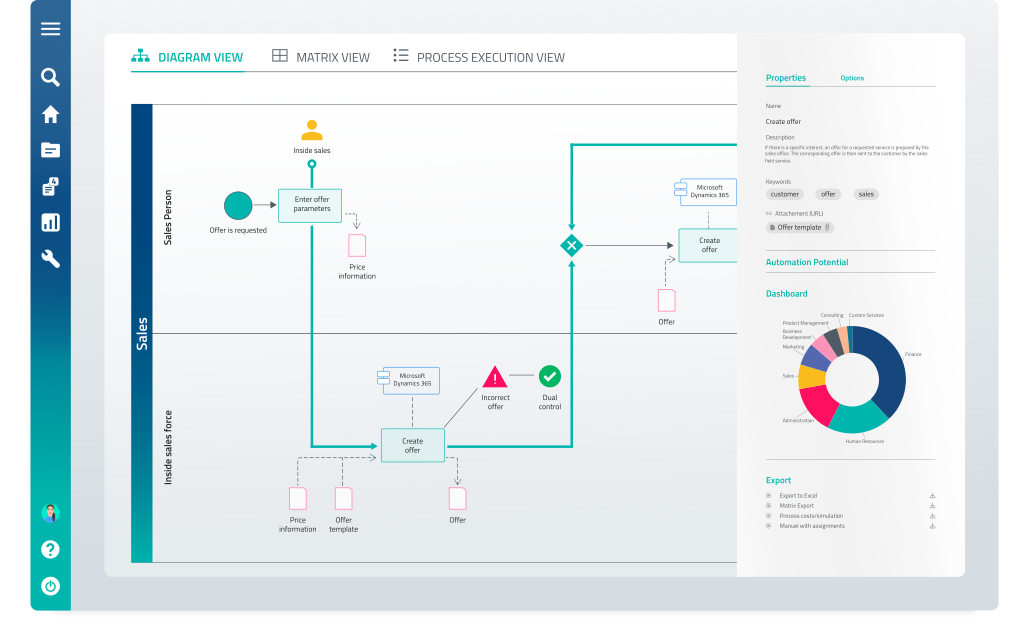
Of course, the processes themselves need to be carefully reviewed across the board to bring them into line with operational best practice too. The consistent application of rules and requirements will ensure that the AI tools have the right environment to make a difference. Documenting, analysing, and assessing the existing processes will provide the launching point for this, and is another area AI can contribute to. With sound processes established that integrate both existing systems and effective governance, the tools can then be unleashed to accelerate execution without bottlenecks and breakdowns.
Better pressure with less problems
Like a plumbing refit, the benefits of AI process standardization are an increase in the flow from meter to revenue and a reduction in the leaks and breakdowns along the way. Partnered with a clear enterprise architecture, it supports more efficient and accurate billing with a clearer perspective on the underlying costs and risks. By knowing the capabilities and lifespan of your systems, and engaging them with refined and consistent processes, AI tools allow for reduced costs and cleaner execution, as only legitimate exceptions to business-as-usual practices require manual input. Errors are reduced, and that translates to fewer disputes, improving customer trust and satisfaction. By clarifying and tightening processes and procedures with a tool like BIC Process Design, then deploying targeted AI tools, issues of compliance and governance can be reduced, and human agents can focus on improving customer outcomes in those cases that don’t fall within the usual parameters.
The meter-to-cash pipeline is a vital part of any utility enterprise, and too valuable to leave as a tangled mix of legacy systems and unoptimised technology. By implementing AI-driven process standardization, that essential conduit of value can be strengthened and streamlined to create sustainable solutions for data-driven success in the energy industry.
Ready to turn strategy into sustained transformation?
Discover how process thinking became part of the operational fabric at Horizon Power, from executive strategy through execution, and what that can teach utilities of all types about driving real, sustained transformation.
GBTEC Software AG
Gesundheitscampus-Süd 23
44801 Bochum
Germany
