




AI Process Maturity roadmap: Is your company truly AI-ready?
 24 June 2026
 For most organisations, the need to become AI-ready is no longer in question. The real challenge lies in accurately assessing where they actually stand today.
The answer lies in the AI Process Maturity Model – a structured framework that evaluates how prepared an organisation’s processes are for AI, based on factors such as standardisation, data quality, governance, automation potential and human-machine collaboration.
Knowing which level your organisation occupies is the prerequisite for building a credible AI readiness roadmap.
Why measurement comes first
The temptation in any transformation programme is to move directly to action: map the future state, select the technology and deploy the solution. The problem with this sequence is that it skips the step that makes all subsequent decisions defensible – an honest, objective AI maturity assessment of the current state.
GBTEC’s 2025 research, which draws on insights from 600 senior business and operations leaders across multiple regions and functions, indicates that most organisations still lack the operational foundations required for successful AI and automation initiatives and that confidence in underlying processes often lags behind transformation ambition. Vendors present a favourable picture. Internal champions advocate for readiness. And programmes are launched on foundations that have not been tested.
The consequences of skipping measurement are not theoretical. Only 48% of organisations report having sufficiently structured, integrated, and governed processes to support advanced AI use cases. This suggests that many organisations still need to strengthen their process foundations before they can confidently scale agentic AI. Addressing process weaknesses late in transformation programmes can create avoidable complexity and delay, which is why early assessment is valuable.
Measurement is not a bureaucratic prerequisite. It is the single most commercially valuable step an organisation can take before committing to AI investment.
AI Process Maturity: The five levels and what comes next
Process maturity frameworks have been used by operational excellence practitioners for decades. The AI era has not changed the structure of these models – it has raised the stakes attached to each level. An organisation that might have functioned adequately at Level 2 process maturity in a human-speed operational environment will find that same maturity level catastrophically insufficient when AI agents are executing decisions at machine speed.
The following five levels outline how process maturity evolves and what is required to progress to the next stage.
Level 1 – Chaotic
Processes exist but are neither documented, standardised, nor consistently followed. Instead, execution relies heavily on tribal knowledge. At the same time, data is fragmented across multiple systems, with no single source of truth.
Under these conditions, introducing AI does not create efficiency – it accelerates inconsistencies. Organisations at this level are therefore not AI-ready.
The immediate priority is to establish a solid foundation: processes must be captured, documented and standardised. Only once this groundwork is in place does it make sense to consider AI.
Recommended next steps:
- Conduct a process inventory for the top ten core operational processes
- Document the current state using Business Process Model and Notation (BPMN)
- Assign clear process ownership
- Establish a centralised process repository
- Define a basic governance framework
Level 2 – Defined
Core processes are generally documented and followed, but standardisation remains incomplete. Data quality is inconsistent across processes and teams, and governance exists only in isolated areas rather than as a systematic framework. Most large organisations operate within this range.
On this level, AI can be piloted in carefully selected, well-governed use cases. However, broader deployment introduces significant risk until standardisation and data governance are strengthened.
The priority is to build consistency and control: expand process documentation, define and enforce data quality standards, and begin measuring process performance.
Recommended next steps:
- Extend documentation coverage across all critical processes
- Establish and enforce data quality standards
- Introduce process performance measurement
- Select one or two tightly scoped AI pilots in areas with strong documentation and high data quality
- Use pilot learnings to systematically strengthen governance across the organisation
Level 3 – Managed
Processes are standardised, documented, and actively governed. Performance is consistently measured, data quality standards are defined and largely met, and clear ownership exists at the process level. Change management follows a structured approach.
This level represents the minimum viable foundation for responsible AI deployment at scale. Organisations here can move beyond isolated pilots toward broader programmes, provided appropriate safeguards are in place.
The focus now shifts to integration: connecting process intelligence with AI execution, automating performance monitoring, and extending governance across the full process lifecycle – including AI-specific exception handling and change control.
Recommended next steps:
- Integrate a process intelligence platform with AI execution infrastructure
- Automate process performance monitoring and feedback loops
- Extend governance frameworks to cover AI-specific risks, including exception handling and change control
- Scale AI deployment beyond pilots into coordinated programmes
- Map the process portfolio against the eight AI readiness principles to identify and close remaining gaps
Level 4 – Optimised
Processes are continuously improved based on performance data. Automation is deployed systematically, system integration is robust, and governance frameworks cover the full process lifecycle. AI augmentation is already embedded and delivering measurable value.
On level 4, organisations are truly AI-enabled. AI enhances human decision-making and automates high-volume, rules-based work at scale.
The focus now shifts to expansion: extending AI capabilities across the process portfolio and embedding them into day-to-day operations. The process intelligence platform evolves into a critical operational backbone – serving as a shared, real-time reference that both humans and AI agents interact with during execution.
Recommended next steps:
- Scale AI-driven and agentic workflows across additional processes
- Position the process intelligence platform as the central operational layer for both human and AI participants
- Strengthen system integration to support real-time, end-to-end execution
- Continuously optimise processes based on performance data and AI insights
- Audit existing AI deployments against the eight AI readiness principles
- Identify and resolve remaining gaps in process clarity, data quality, and governance
Level 5 – AI-powered
AI is embedded across end-to-end processes, with agentic workflows executing autonomously within defined governance boundaries. Human expertise is focused on strategy, exception handling, and continuous improvement. The process intelligence platform acts as a shared, governed source of operational truth for both human and AI participants.
Only a small proportion of organisations currently operate at this level. For most, it represents a medium-term ambition rather than an immediate reality.
The challenge now is governing AI at scale: as agentic workflows expand, organisations must ensure that the process intelligence platform remains the authoritative and continuously updated reference point – and that AI behaviour constantly stays within defined boundaries.
Recommended next steps:
- Establish a continuous AI process governance function
- Ensure the process intelligence platform remains the authoritative, real-time source of process truth
- Monitor and manage agent performance across all workflows
- Implement controls to prevent drift in AI behaviour and decision-making
- Formalise change management for AI-driven processes to maintain system reliability at scale
The six dimensions you must measure
Moving up the AI maturity levels requires measurement across six distinct dimensions. These are not arbitrary categories – they reflect the six critical factors that determine whether an AI system will perform reliably in an operational environment, and they correspond directly to the dimensions assessed by GBTEC’s AI Readiness Benchmark.
1. Standardisation and documentation
Are your processes clearly defined, consistently followed, and documented in a form that both humans and AI systems can interpret without ambiguity? Written procedures leave room for misinterpretation. Structured process notation, particularly BPMN, removes that ambiguity entirely. An AI agent working from a well-formed BPMN model has unambiguous instructions. An AI agent working from a prose procedure document is making judgement calls.
Key questions:
- What percentage of your core processes are formally documented?
- What percentage use structured notation?
- Are those documents maintained as living assets or treated as one-time deliverables?
2. Automation potential
How much of your process portfolio is genuinely automatable, and at what level of maturity? Automation potential is not simply a function of task complexity – it depends on data availability, exception frequency, integration readiness, and governance maturity. A process that looks automatable on paper may be fundamentally unready for AI execution due to gaps in any of these supporting dimensions.
Key questions:
- Have you mapped your process portfolio against automation readiness criteria?
- Do you have a clear picture of which processes are candidates for full autonomy, augmentation, or human-led execution?
3. Data quality and availability
AI systems are only as reliable as the data they operate on. Poor data quality due to inconsistency, incompleteness, inaccessibility or duplication produces unreliable AI outputs regardless of model sophistication. In distributed IT environments, data silos and technical heterogeneity compound this challenge significantly.
Key questions:
- Do you have a defined, enforced data quality standard for each core process?
- Is there a single, governed source of truth for operational data?
- Are data ownership responsibilities clearly assigned?
4. Process performance management
Can you measure what your processes are actually doing? Do you have the observability infrastructure to detect when something goes wrong before a customer or regulator finds it first? At Level 5 AI maturity, performance monitoring is not a periodic review activity. It is a continuous, automated feedback loop that surfaces anomalies, triggers escalations, and drives continuous AI process improvement in near real time.
Key questions:
- Are KPIs defined for each core process?
- Is performance data captured automatically or manually?
- Do you have the capability to detect process failures before they escalate?
5. Collaboration and human-machine interaction
The transition to AI-augmented and AI-autonomous processes is not a binary switch. It is a gradual migration in which humans and AI agents work alongside each other, with responsibilities shifting over time. The AI process governance model must reflect this reality – defining clearly where AI has authority to act, where it must escalate to a human, and how decisions are logged and auditable.
Key questions:
- Have you defined the human-AI collaboration model for each process in scope?
- Are escalation protocols explicit and tested?
- Is there audit trail capability for AI-executed decisions?
6. Agility and adaptability
Processes that cannot adapt to change become bottlenecks at the pace AI enables. The ability to update process logic, reconfigure governance rules, and respond to market or regulatory change – without breaking AI-dependent workflows – is a critical maturity requirement that many organisations underestimate. AI change control mechanisms are essential here: without them, process updates can silently invalidate the logic AI agents are operating against.
Key questions:
- How quickly can you update a process design and propagate that change to all systems and agents that depend on it?
- Do you have change control mechanisms that maintain AI workflow integrity through process updates?
The process intelligence platform: Your AI operating system
Across every maturity level, one asset appears constantly: a process intelligence platform. This is not a coincidence. It is the logical conclusion of what AI actually needs to function.
Think of the process intelligence platform as the London Underground map for AI agents. An agent needs to know exactly where it is allowed to go, what rules it must follow, who it needs to hand off to, what risks and controls apply, and what regulations it must satisfy. Without that map – a structured, machine-readable, continuously governed representation of how the business actually works – an AI agent is navigating by guesswork.
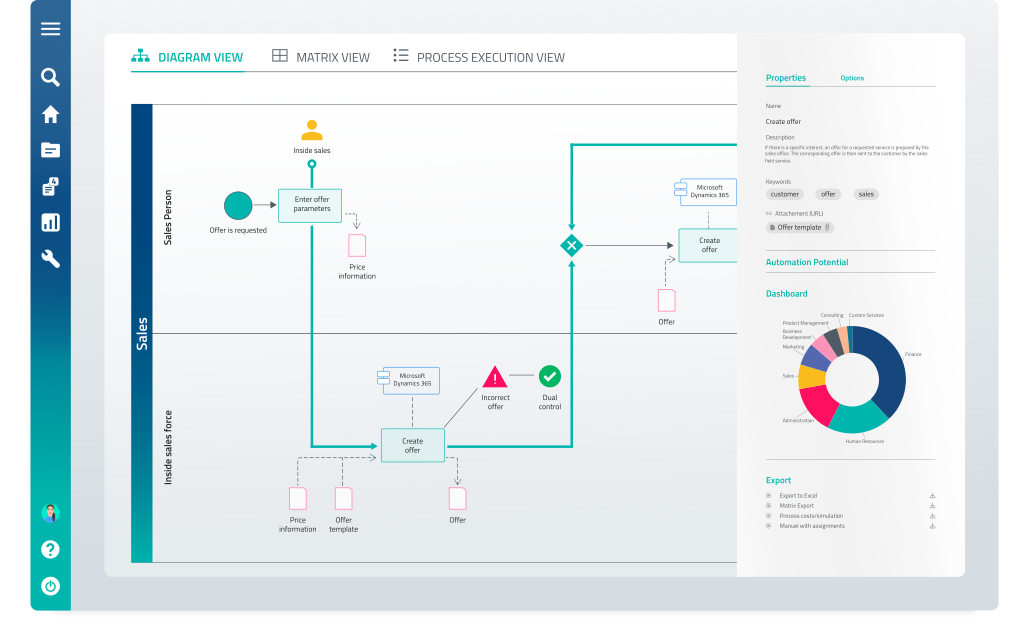
The GBTEC Platform, combining GBTEC Process Design, GBTEC Work Orchestrator, and GBTEC Enterprise Architecture, is specifically engineered to serve this function. It provides the structured process logic that AI agents require, the governance frameworks that keep them operating within defined boundaries, and the performance observability that enables continuous improvement. It is the platform on which both human and AI participants in a business process can rely.
Frequently asked questions
How do I assess my AI maturity level?
The most reliable way to assess your AI maturity level is through a structured AI maturity assessment that evaluates your organisation across the six key dimensions of process readiness: standardisation and documentation, automation potential, data quality and availability, process performance management, human-machine collaboration, and agility and adaptability. GBTEC’s AI Readiness Benchmark does exactly this in five minutes, providing a benchmarked score against 600 senior leaders globally. Without an objective assessment, organisations tend to overestimate their readiness – which is one of the primary reasons AI programmes fail.
What are the steps to become AI-ready?
The AI readiness roadmap varies depending on your current maturity level, but the sequence follows a consistent logic. At level 1, the priority is process documentation and standardisation – AI cannot operate reliably on undocumented processes. At level 2, the focus shifts to data governance and tightly scoped pilots. At level 3, organisations are ready to scale AI deployment with appropriate safeguards, connecting their process intelligence platform to AI execution infrastructure. At level 4, the work is expanding agentic workflows and auditing existing AI deployments for governance gaps. At level 5, the challenge is maintaining AI-enabled process governance at scale as autonomous workflows proliferate.
What is a process intelligence platform, and why does AI need one?
A process intelligence platform is a centralised, structured, machine-readable representation of how an organisation’s business processes work – including the systems they run across, the governance rules that apply, and the performance data used to measure them. For AI agents, this platform functions as an operating system: it tells them where they are allowed to act, what logic to follow, when to escalate to a human, and what risks and compliance requirements apply. Without a process intelligence platform, AI agents navigate by guesswork – making assumptions about process steps, decision rights, and exception scenarios that can produce significant downstream errors.
What governance does AI need at scale?
As organisations move from level 4 to level 5 of AI maturity, AI process governance becomes the critical constraint. Governance at scale requires a dedicated function responsible for maintaining process integrity across human and AI workflows; AI change control mechanisms that ensure process updates propagate correctly to agent behaviour without breaking live workflows; continuous monitoring of agentic workflow performance against defined KPIs; clear escalation protocols that route novel or high-risk decisions to human judgement; and a process intelligence platform that serves as the authoritative, continuously updated source of process truth. Organisations that do not build this governance infrastructure before scaling will find that AI agent behaviour drifts unpredictably as the complexity of the deployment grows.
Why is benchmarking essential for AI readiness?
Benchmarking is essential because organisations consistently overestimate their AI readiness without external reference points. Internal assessments are subject to optimism bias – champions advocate for readiness, vendors present favourable capability pictures, and boards receive reassurance rather than measurement. A benchmark grounded in data from a broad peer group – like GBTEC’s AI Readiness Benchmark, validated against 600 senior leaders globally – provides the objective baseline that responsible AI investment requires. It identifies not just where gaps exist but also how significant those gaps are relative to organisations at comparable maturity levels, making it possible to prioritise remediation efforts and sequence AI investments in the right order.
Start with the Benchmark
The roadmap above is only useful if you know your current position on it. That is why the single most important action any CIO, process leader, or transformation executive can take right now is to obtain an objective, data-backed assessment of their organisation’s AI process maturity.
GBTEC’s AI Readiness Benchmark delivers that assessment in five minutes. It scores your organisation across the six dimensions of process readiness, benchmarks those scores against 600 senior leaders globally, and provides a clear, tier-specific path forward. It is free, evidence-based, straightforward and honest.
Organisations that know where they stand are the ones that build on solid foundations. Those who skip assessment are the ones contributing to the 70% AI failure rate. The question is not whether AI transformation is coming. It is whether your processes will be ready for it when it arrives.
GBTEC Software AG
Gesundheitscampus-Süd 23
44801 Bochum
Germany
