



Rationalise or Fail: The AI Challenge
for Utilities
 24 February 2026
 You Only Have to Look Around
You only have to walk past a mall parking lot with rows of vehicle charging stations, or a suburban house that has sparkling solar panels spread across its roof to know that the energy industry has changed significantly in recent years. There was a time not so long ago when power grids were one-way systems, with centralised generation feeding enormous distribution networks to consumers. Demand was predictable, and information flowed slowly, often through analog systems and manual processes.
Today’s digital grids are light-years apart from that. The growth of the electric vehicle market and the adoption of solar and home storage solutions means energy flows both ways in the grid, and demand is much less routine. Networks have evolved technologically too, creating complexity that extends beyond simple upgrades. Where once outages were discovered too late, they can now be spotted instantly, and crews or systems can spring into action without delay.
The Hidden Risk of Complexity
Utility landscapes are historically grown, asset-centric, and heavily regulated. Over decades, this has led to multiple parallel systems per region, layered legacy systems that were “temporary” but became permanent, and a strong separation between OT systems (SCADA, DMS, GIS) and IT systems (ERP, CIS, CRM, EAM). The result is high cost, low transparency, slow change, and rising operational risk.
In this environment, technology rationalization is no longer an IT efficiency exercise. It has become the foundation of operational excellence, regulatory compliance, and AI readiness. Utilities cannot hope to deploy AI or automation on top of a fractured landscape. Without simplification, AI amplifies inefficiency and risk rather than creating value.
Enterprise Architecture leaders face the daunting task of making sense of this complexity. They must determine which applications are truly critical, which are redundant, and which are holding back standardisation and automation. They must understand where process variation has crept in, often silently, and where data quality is compromised. These are not abstract concerns, they directly affect reliability, regulatory defensibility, and the ability to innovate safely.
AI Makes Rationalization Unavoidable
AI adds urgency to this challenge. Utilities want predictive maintenance, AI-assisted outage management, intelligent workforce dispatch, and AI-driven customer service. But AI cannot deliver these outcomes on top of architectural chaos. Inconsistent data models, fragmented processes, and unclear ownership of systems create “black box” risks that regulators will not tolerate. Enterprise-wide AI adoption requires a clean, rationalized landscape, one where processes and data flows are consistent, visible, and auditable.
Technology rationalization becomes a prerequisite for:
- Trustworthy AI
- Explainable decisions
- Regulatory-safe automation
- Enterprise-wide AI adoption
Fusing EAM with BPM for a Single Source of Truth
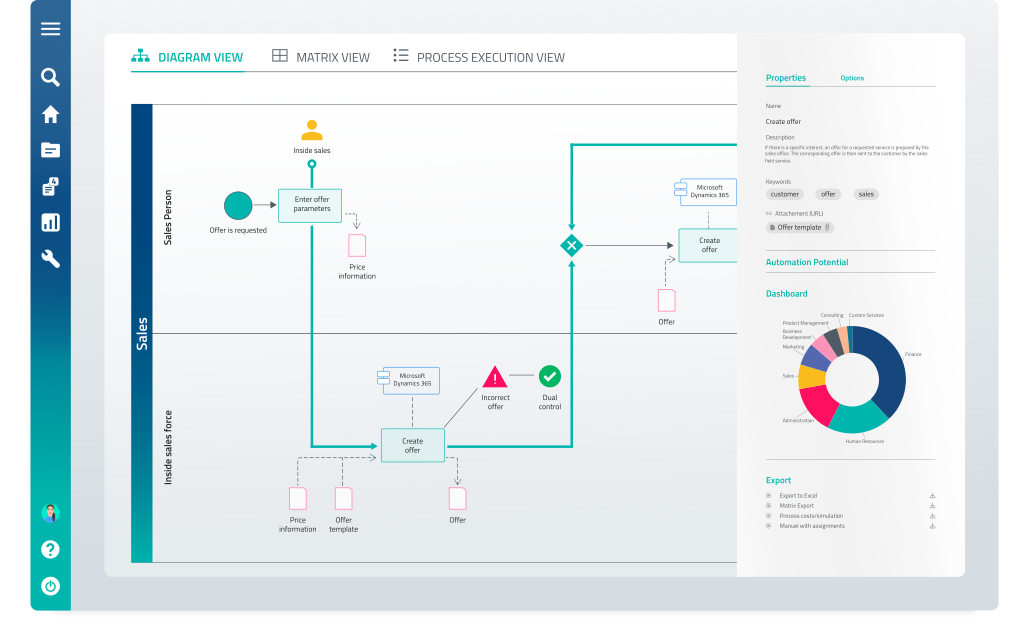
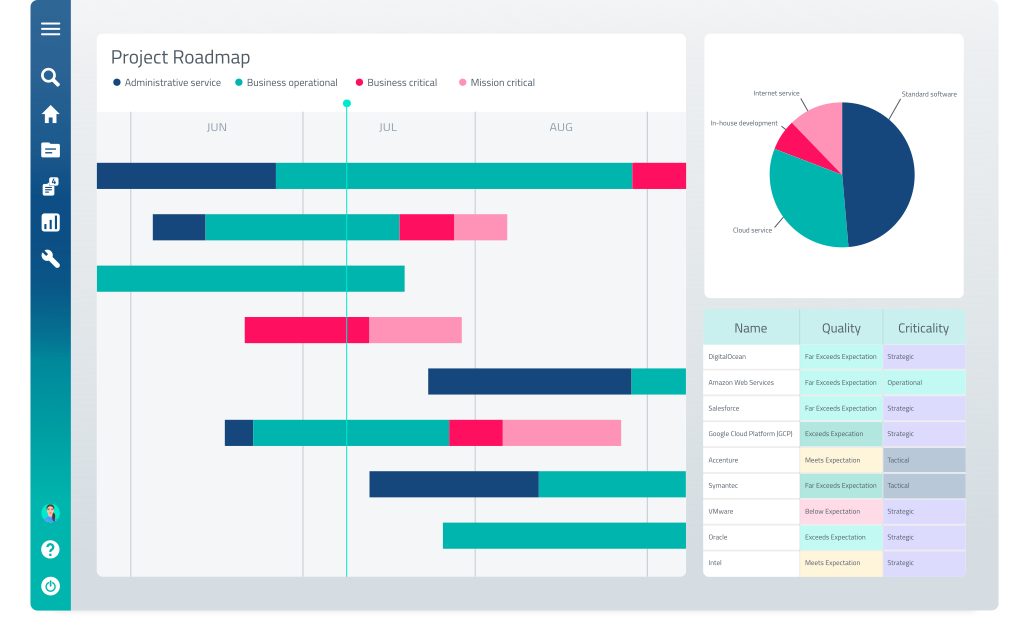
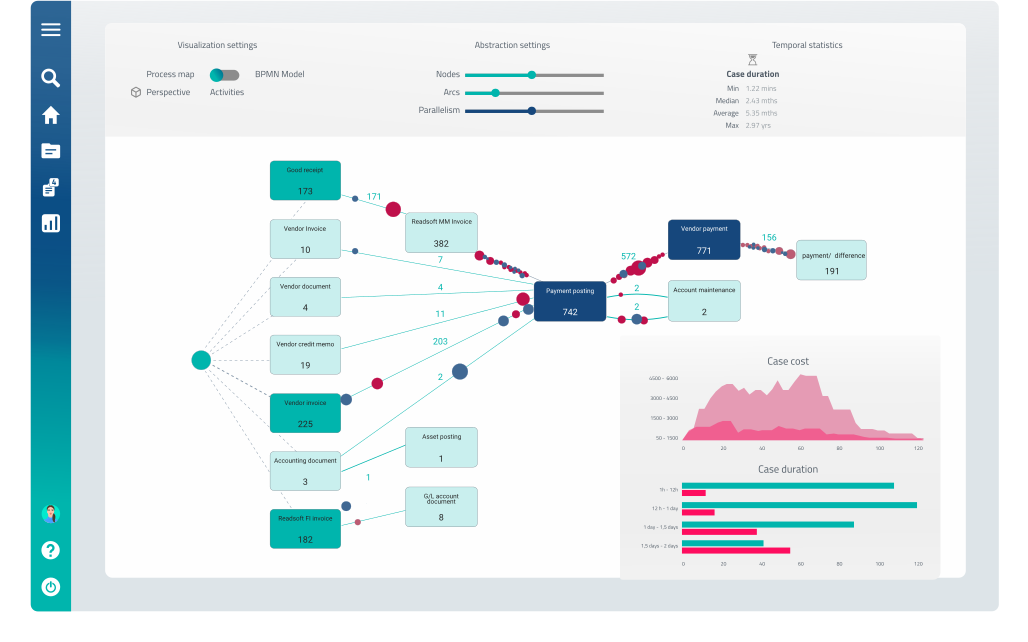
This is where GBTEC’s platform comes in. BIC Enterprise Architecture Management provides transparency across the application landscape, highlighting redundancies, dependencies, and risks before any system is retired or modernised. BIC Process Design complements this by mapping how applications are actually used in day-to-day operations, revealing process variants, manual workarounds, and hidden compensating logic. Together, they create a single, coherent view of both process and technology, the foundation for safe modernization and AI readiness.
The real breakthrough happens when process and architecture are treated as one conversation. Horizon Power, a large Australian power supplier, serves as an example. By establishing a shared process architecture linked directly to systems, data, and roles, they were able to:
- Identify true functional overlap
- Understand which systems were critical versus historical
- Simplify their landscape without destabilising operations
Horizon Power embedded governance directly into their process and architecture practices, supported by a central repository rather than disconnected documents. Platforms like GBTEC make this practical, maintaining traceability from regulation → process → system → control. Their experience illustrates what a future-ready utility operating model looks like: clear ownership, a shared language, visible dependencies, and a platform that connects strategy to execution.
A Foundation for Safe Modernization
With a rationalized portfolio and standardized processes, utilities can modernise confidently. Automation and AI can be deployed on a foundation that is safe, explainable, and defensible. Regulators, auditors, and stakeholders can trace decisions from process design to system execution to outcomes. Operational noise is reduced, reliability improves, and the organization is ready to take advantage of emerging technology rather than being overwhelmed by it.
Technology Rationalization: The Unsung Hero
Technology rationalization is often overlooked in conversations about digital transformation, yet it is the unsung hero of successful utility modernization. It allows organizations to move beyond firefighting and heroics toward controlled, measurable change. It makes AI adoption not just possible, but strategic. And it gives leaders the confidence that modernization, automation, and regulatory compliance can coexist.
Key Insight
For utilities, rationalization is not about cutting costs or ticking boxes. It is about creating a landscape where the full potential of technology, process, and data can be realized. With a platform that combines EAM and Process Design capabilities, utilities gain a transparent, process-aware, and AI-ready foundation, enabling them to simplify their landscape, modernise with confidence, and deploy AI responsibly at scale.
Discover how utilities are building the digital foundation for modern environments.
GBTEC Software AG
Gesundheitscampus-Süd 23
44801 Bochum
Germany
