




Taming Complexity in Utilities: Lessons for the CIO
 17 March 2026
 Landing in Complexity
Stepping into a utility as a CIO can feel like landing in a world both familiar and strange. On the surface, the technology landscape is impressive: SCADA, DMS, GIS, ERP, CIS, EAM, analytics platforms, each system vital, each claiming to improve efficiency. Yet, as the first few weeks pass, the sense of control can slip away. Complexity becomes visible not in the systems themselves, but in the way they interact, overlap, and sometimes conflict.
Utilities aren’t struggling because they lack technology. They struggle because the technology they have is compensating for invisible gaps in process and ownership. Every system tells a story, but the story changes depending on who you ask. The same process may run one way in the field, another way in IT, and yet another in regional offices. Applications become islands of logic, filled with workarounds and exceptions that no one fully documents. Knowledge critical to decision-making lives in people’s heads, not in a governed model. And when change is introduced, a new CIS platform, a cloud migration, or a pilot for predictive maintenance or AI, the risk multiplies, often in ways that are invisible until it’s too late.
The CIO Paradox
Transformation is no longer optional. Boards expect it. Regulators demand it. Customers anticipate it. Yet the operating model was never designed for rapid, transparent, or auditable change. CIOs must modernise IT and OT landscapes, reduce technology debt, and enable automation and AI, all without compromising reliability, affordability, or regulatory compliance.
This creates a paradox, transformation is mandatory, but instability is unacceptable.
Risks You Can’t See
Most risks CIOs face today are not caused by new platforms or emerging technologies. They come from what already exists, including,
- Processes executed differently across regions, systems, or asset classes
- Legacy IT and OT systems filling in gaps for unclear processes
- Application landscapes multiplied by mergers and point solutions
- Critical operational knowledge living in people’s heads rather than documented models
When change is introduced, cloud migrations, CIS replacements, AI pilots, risk doesn’t add up. It multiplies. Dependencies surface late. Exceptions explode. Accountability becomes blurred, and when something goes wrong, CIOs are left explaining decisions that were never fully visible in the first place.
What often goes unspoken is the personal risk this creates for utility leaders, every outage, every audit, every customer impact lands squarely on their shoulders. Rationalisation matters because it gives leaders confidence that when they change something, they understand the consequences and can defend those decisions to executives, auditors, and regulators alike.
Why “Just Integrate the Systems” Isn’t Enough
IT/OT integration is often positioned as the answer. In reality, it can amplify chaos. Without clear ownership of the processes that span IT, OT, and operations, integration simply connects dysfunction to more dysfunction. Each domain performs perfectly in isolation, but the system fails as a whole.
Utilities that break this cycle start differently, they make processes explicit, assign ownership, and govern them across functions. Once processes are visible and owned, systems can be rationalised, modernised, and integrated without creating new fragility.
Lessons from Horizon Power
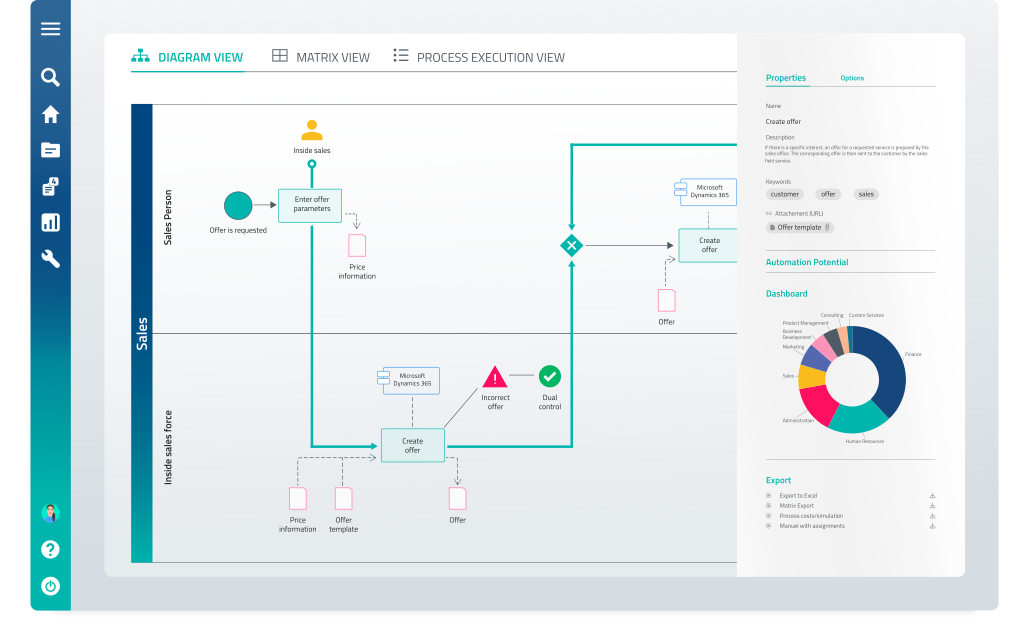
Horizon Power provides a striking example. Before scaling AI initiatives or automating operations, they invested in creating a shared, end-to-end view of how work flows across IT, OT, and operational teams. Process variants were documented, dependencies understood, and governance embedded.
This approach allowed them to rationalise applications safely, link systems to outcomes, and gradually introduce automation and AI where it added value, not risk. The transformation didn’t rely on manual fixes, it relied on clarity.
AI, Modernization, and Process Ownership
AI can feel like both an opportunity and a threat. Many utilities want predictive maintenance, AI-assisted outage management, and intelligent workforce dispatch. Yet in practice, AI often exposes hidden gaps in processes and ownership.
Another hidden barrier to AI and modernization is the lack of clear ownership over end-to-end processes, spanning IT, OT, and Operations, which can make integration work technically but fail operationally. Rationalisation only succeeds when utilities establish shared process ownership, creating a common language for how systems, data, and people work together. Without it, organizations often experience,
- Integration that works technically but fails operationally
- Process variants that emerge unnoticed
- Workarounds that become institutionalized
- Blurred accountability when incidents occur
Platforms like GBTEC BIC Platform can support CIOs here, providing a neutral, process-aware layer that links strategy to execution and allows decisions to be made with confidence. The platform doesn’t replace leadership or innovation, it illuminates the terrain before the leap.
Connecting Processes to Outcomes
For CIOs, the lesson is clear, technology alone cannot deliver transformation. It must sit on a foundation of processes that are visible, governed, and linked to outcomes that matter, reliability, regulatory compliance, and customer satisfaction. Incremental change, measured against these outcomes, is safer and ultimately more effective than sweeping, fast-moving projects.
Navigating Tension: Stability vs Change
Transformation in utilities is a story of tension, stability versus change, operational certainty versus technological opportunity, regulatory defensibility versus innovation. The CIO’s role is to navigate these tensions, turning complexity into clarity. It requires patience, visibility, and a willingness to question assumptions about how work flows, where decisions are made, and which systems truly matter.
When done right, modernization stops feeling like a gamble and starts feeling like a carefully charted journey.
From Reactive Effort to Designed Reliability
Technology rationalization is often overlooked in conversations about digital transformation, yet it is the difference between change that relies on manual fixes and change that is engineered for safety. In many utilities today, success still depends on individual expertise, tribal knowledge, and last-minute intervention when systems or processes fail. That approach does not scale, and it does not survive AI.
Rationalisation replaces courage with control, making dependencies visible, ownership explicit, and outcomes predictable, the foundation for incremental, confident modernization. For utilities, rationalisation is not about cutting costs or ticking architectural boxes. It is about creating an operating model where leaders can modernise without fear, where regulators can trace decisions with confidence, and where technology finally supports, rather than obscures, how work gets done.
For CIOs in utilities, the lesson is not that transformation must slow down but that it must become more intentional. The most effective CIOs are not those who move fastest, but those who make complexity visible, ownership explicit, and change defensible. By grounding modernization in shared process understanding and architectural clarity, CIOs shift the conversation from risk mitigation to confidence-building. In doing so, they move from reacting to complexity to shaping it. Ultimately, this repositions transformation: from appearing as a gamble into a disciplined leadership capability.
With GBTEC’s combined BIC Enterprise Architecture Management and BIC Process Design capabilities, utilities gain a transparent, process-aware, and AI-ready foundation, one that enables them to simplify their landscape, modernise safely, and deploy AI responsibly, not through manual fixes, but through design.
GBTEC Software AG
Gesundheitscampus-Süd 23
44801 Bochum
Germany
