




The business transformation landscape explained
 19 May 2026
 If you have sat in a transformation steering committee recently, you will have noticed something: everyone is using different words for the same thing – or worse, the same words for different things.
Your CIO is talking hyperautomation. Your Process Lead is talking automation. Your Enterprise Architect is talking Digital Twin. Your compliance team is asking about governance. And your CEO is wondering why nothing is moving fast enough.
At its core, this is a problem of shared understanding. When terminology is inconsistent, alignment becomes difficult and execution slows down.
The consequences are significant. McKinsey research shows that up to 70% of transformation programmes fail to meet their objectives, often because the foundation is not strong enough and the sequence of activities is unclear.
This article provides a structured overview of the business transformation landscape: what the key methods are, how they relate to each other and in which sequence they create the most value.
What is business transformation?
Business transformation describes the structured redesign of an organisation’s processes, operation model and technology landscape in order to improve performance, adaptability and long-term competitiveness.
In practice, this includes:
- redesigning processes
- introducing automation and AI
- aligning IT architecture
- embedding governance and compliance
Successful transformation depends less on individual technologies and more on how these elements are connected within a coherent framework.
The five pillars of business transformation
1. Understand & Discover
Every transformation starts with a shared understanding of how the organisation works.
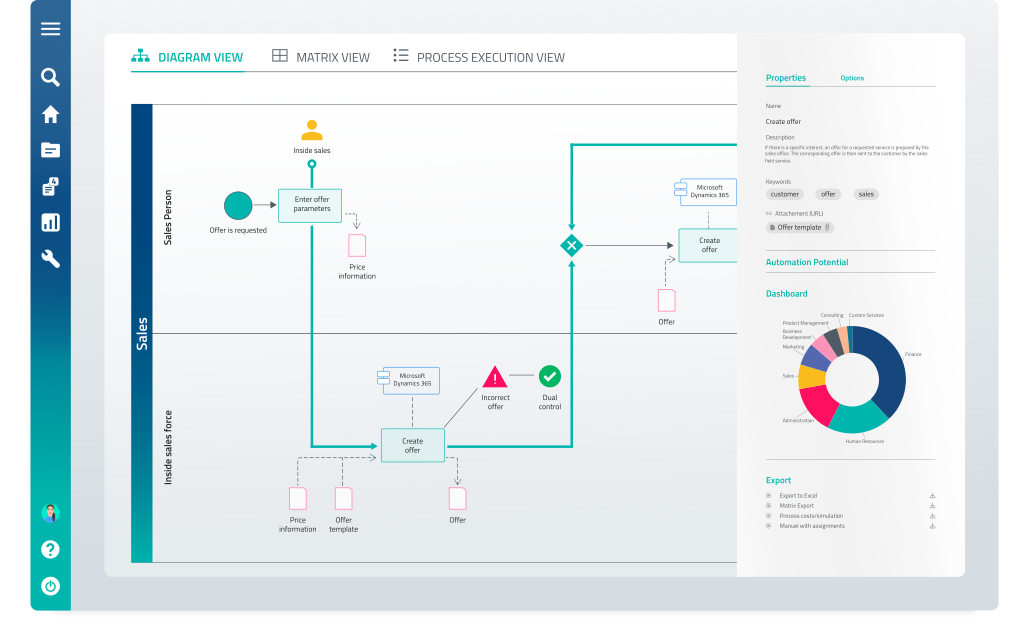
Business Process Management (BPM) provides a common language for modelling processes, identifying improvements and ensuring consistency across the transformation journey. Standardised notations make process designs transparent and actionable across the entire organisation.
Without a shared process model, every other transformation effort builds on sand. Discovery has nowhere to anchor. Automation has nothing reliable to execute. Governance has nothing to audit against.
The most powerful tool in this pillar today is the Digital Twin – a virtual replica of your operations that lets you simulate changes, test automation scenarios and model regulatory impact before committing a single resource to production.
Also in this pillar: Target Operating Model, Enterprise Architecture Modelling, Journey Mapping, Capability Modelling and a high-level scoping tool that captures the key elements of any process, helping teams align on scope and boundaries before diving into detail.
The anti-pattern: modelling an ideal future without grounding it in operational reality. Beautiful process diagrams that the business cannot actually deliver.
2. Design & Model
Once you have a process model as your foundation, discovery tools tell you how reality compares to the design.
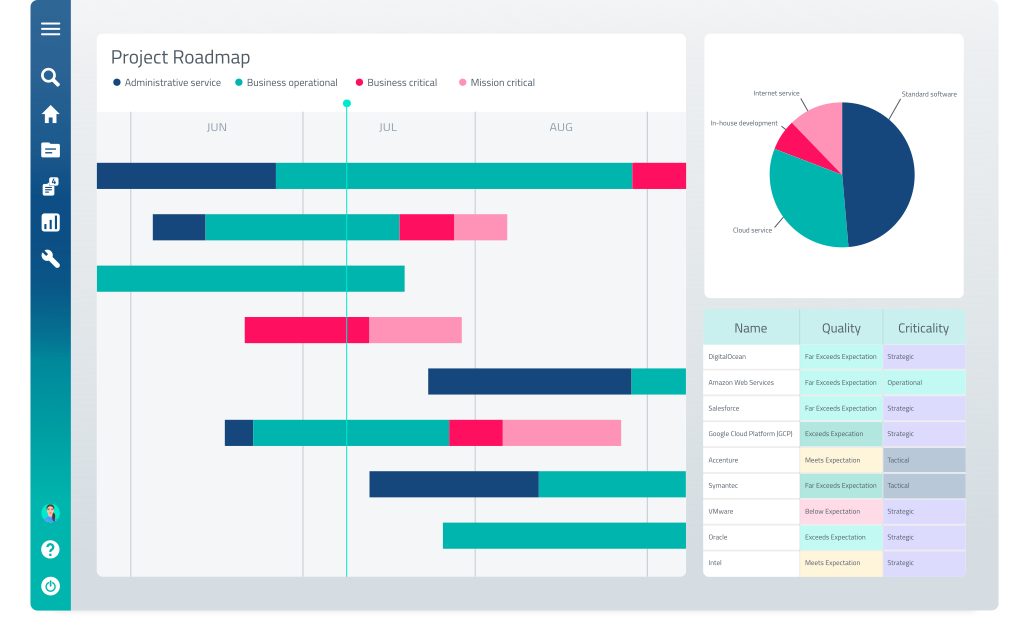
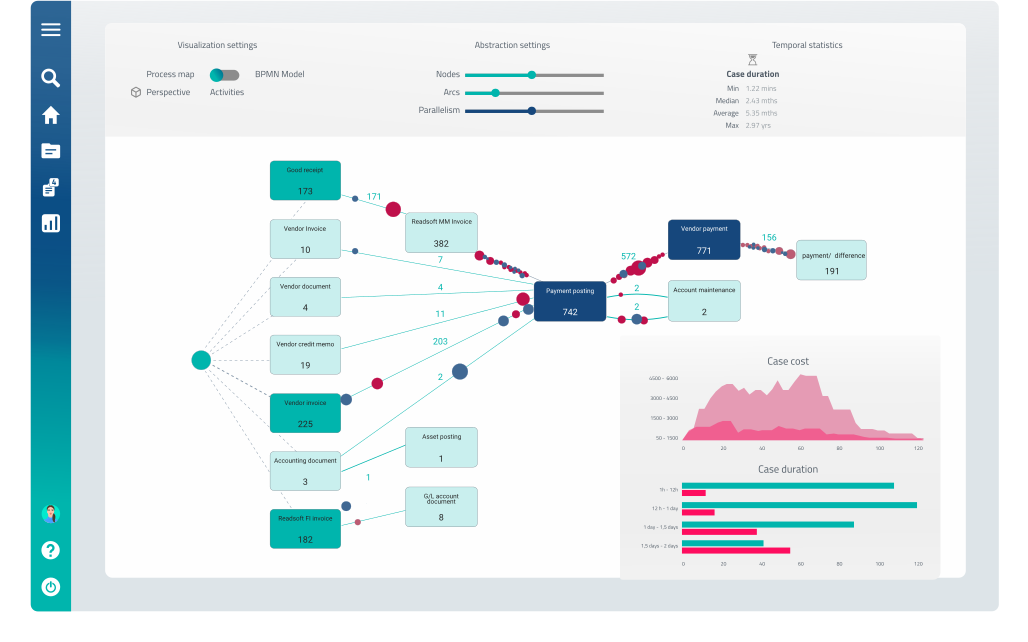
Process mining plays a central role here. It extracts actual process flows from your systems – showing you through data where the bottlenecks, deviations and waste really occur.
Task Mining goes one level deeper, capturing desktop-level user behaviour to identify repetitive manual work.
Conformance checking compares actual behaviour against your designed process, critical for compliance and audit readiness.
Process discovery and documentation focus on collaboratively documenting and aligning the current state through workshops and structured documentation. It ensures that what exists in practice is visible and shared before any redesign begins.
Also in this pillar: Value Stream Mapping, Process Intelligence, process benchmarking and data analytics.
The anti-pattern: skipping discovery and designing solutions for the process you imagine rather than the one that exists.
3. Optimise & Improve
Discovery tells you what is broken. This pillar fixes it before automation touches anything.
Lean thinking eliminates waste systematically. Six Sigma reduces variation and defects using data. The structured improvement cycle of define, measure, analyse, improve and control provides a rigorous framework for working through each improvement. A complementary four-step cycle of plan, do, check and act supports continuous testing and refinement at a practical level.
The most important goal across this pillar is to create a continuous improvement mindset – not a one-time fix, but an ongoing discipline that keeps processes performing as the organisation evolves.
Also in this pillar: daily improvement practices, Root Cause Analysis, Constraint Identification, agile delivery methods and outcome-based goal frameworks.
The anti-pattern – and the most expensive mistake in transformation: automating before optimising. You do not automate a broken process. You automate a clean, stable, well-designed one.
4. Automate & Execute
Only once processes are designed, discovered and optimised should automation enter the picture.
Here is how the most confused terms actually relate to each other:
- Intelligent automation adds artificial intelligence to handle unstructured data, exceptions and decisions that rule-based automation cannot manage.
- Hyperautomation is the orchestrated combination of artificial intelligence, business process management and analytics at enterprise scale. It is not a product, it is an approach that requires process maturity to deliver on its promise.
- Artificial intelligence and generative AI amplify whatever foundation you have built. If that foundation is solid, these technologies accelerate outcomes. If it is not, they scale your problems.
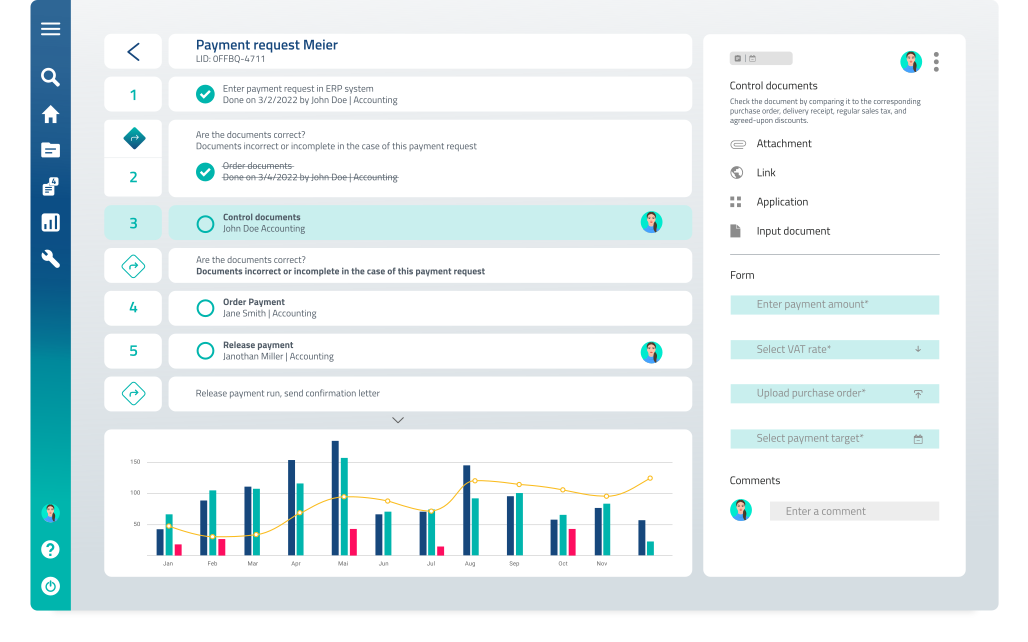
- Rule-based automation of specific repetitive tasks delivers fast and accessible wins, but is brittle if the underlying process is unstable. This is why it belongs at the end of the sequence, not the beginning.
Also in this pillar: Decision Mining, Low-Code and No-Code Development, System Integration Middleware, Process Orchestration and Workflow Automation.
The anti-pattern: treating artificial intelligence as the starting point. It is the accelerant and accelerants are only useful once the foundation is in place.
5. Govern & Scale
The most underdeveloped pillar in most organisations – and the one that determines whether transformation gains stick or erode within eighteen months.
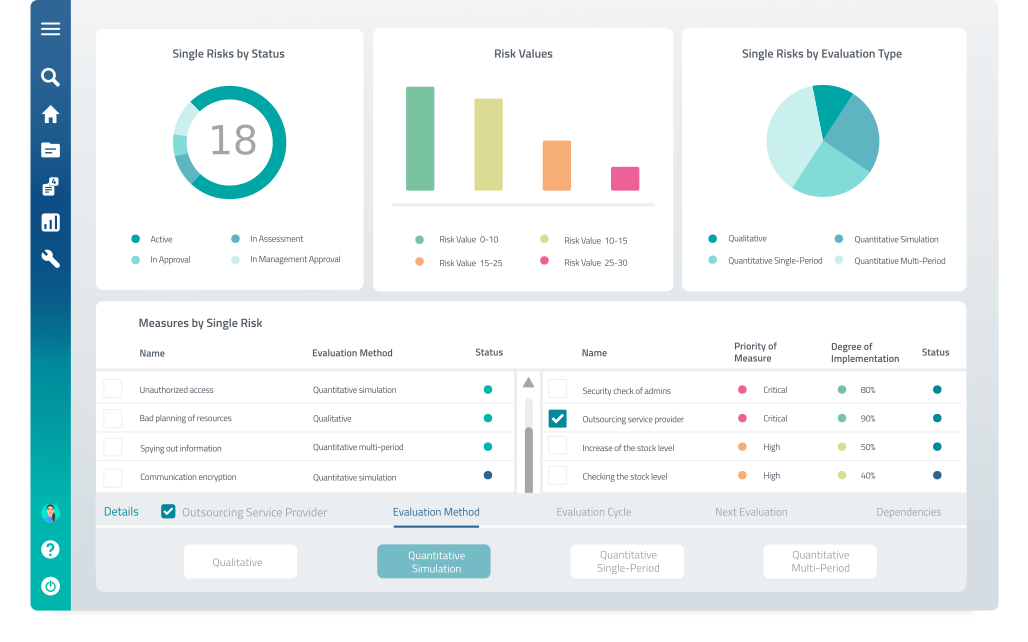
The Centre of Excellence (CoE) is the central hub for transformation capability and standards. Governance, risk and compliance (GRC) is not a separate workstream or a final gate. It is a design input. Regulatory frameworks such as data protection legislation, financial controls, operational resilience requirements and information security standards are not obstacles to transformation. They are requirements that must be built in from day one.
Change Management sits here too – the most underestimated lever in the entire landscape. Technically perfect transformations fail every day because human adoption was treated as a communication task rather than a strategic discipline.
Three internationally recognised frameworks bring additional structure and standards to this pillar. One governs enterprise architecture decisions. Another defines best practices for technology service management and delivery. A third provides a common process classification framework for benchmarking and standardising processes across functions.
Also in this pillar: Process Ownership, Risk Management, compliance monitoring and internal controls.
The anti-pattern: treating governance as a final checkbox. Retrofitting controls into live automations is expensive, disruptive and often impossible.
The correct sequence of business transformation
A structured transformation follows a clear order:
Discover & Mine → Design & Model → Optimise & Improve → Automate & Execute → Govern always
Organisations getting transformation right are not moving faster than their peers. They are moving in the right order.
Apply continuous improvement principles to optimise and stabilise before automation. Layer automation efforts on stable, designed, optimised processes only. And govern always, not as an afterthought.
Skip a step, and the consequences compound, if processes are not stabilised before automation, inefficiencies scale across the organisation. McKinsey's research is clear: most transformation programmes fail not because of technology, but because the sequencing was wrong from the start.
Conclusion
Business transformation becomes significantly more achievable when every role in your organisation is working from the same map – a shared language, a clear sequence and a single source of truth.
The GBTEC Business Transformation Matrix gives teams exactly that. Forty-five or more methods mapped across all five pillars, organised by sequence, role and impact. Free, visual and available instantly, so your next transformation conversation can start from a place of clarity rather than confusion.
Frequently asked questions
What is business transformation in simple terms?
Business transformation is the structured redesign of processes, technology and organisational structures to improve performance and adaptability.
Why do so many transformation initiatives fail?
Many organisations lack a clear sequence and a stable process foundation, which leads to misaligned activities and limited results.
What are the main steps of business transformation?
Understanding current processes, designing a target model, optimising processes, automating execution and embedding governance.
What is the difference between process mining and process discovery?
Process mining uses system data to analyse real execution, while process discovery captures processes through workshops and documentation
What is a digital twin of an organisation?
An organisation’s digital twin is a virtual representation of processes and operations that allows simulation and testing before implementation.
How do automation and hyperautomation differ?
Automation focuses on specific tasks, while hyperautomation combines multiple technologies at scale to transform end-to-end processes.
Download the free Business Transformation Matrix . One map. Every core method. Your starting point. Access the Matrix
GBTEC Software AG
Gesundheitscampus-Süd 23
44801 Bochum
Germany
