




Why AI needs architecture: EAM as the foundation of your AI programme
 24 June 2026
 To bring decisive added value, AI programmes depend on something many organisations tend to overlook: a solid architectural foundation.
AI readiness in Enterprise Architecture describes how well an organisation’s processes, systems and governance structures are documented, connected and governed to allow AI systems to operate safely, traceably and effectively.
Without this foundation, AI cannot work reliably at scale – and the risk of deploying it increases significantly.
The AI investment problem nobody is talking about
Enterprise AI investment has never been higher. Boards have committed significant budgets, technology teams have deployed models and pilot programmes are being launched across virtually every business function.
Yet the outcomes remain inconsistent. According to GBTEC’s 2025 research across 600 senior business and operations leaders, only 17% consider their organisations highly mature in AI-enabled process operations. The gap between AI investment and AI outcomes is not primarily a technology problem but rather an architectural one.
What AI actually needs to deliver value
Whether organisations are deploying AI assistants, process automation, predictive analytics, or agentic AI, the underlying requirements are surprisingly similar.
AI needs:
- Clearly defined processes
- Transparent system dependencies
- Reliable data sources
- Governance and accountability
- Visibility into business impact
Without these elements, AI is forced to operate in an environment where responsibilities, process flows and system relationships are unclear.
The result is predictable: automation amplifies existing inefficiencies, risks become harder to manage, and scaling successful pilots becomes difficult.
Before organisations ask where AI should be deployed, they first need to understand whether their processes and architecture are ready to support it.
The research finding every AI programme should pay attention to
GBTEC's 2025 research revealed a clear pattern:
- 87% of leaders believe AI requires structured and governed processes to deliver value.
- 78% believe AI initiatives will fail without effective process management.
- Only 17% consider their organisations highly mature in AI-enabled operations.
These numbers point to a consistent conclusion: the bottleneck is not the AI technology itself but the absence of a governed, architecturally sound foundation underneath it. Before organisations can build an AI-enabled operating model, they need to know whether their processes and architecture are actually ready to even support one.
Where Enterprise Architecture fits into AI
Enterprise Architecture provides the missing connection between business operations and technology. When Business Process Management (BPM) and Enterprise Architecture Management (EAM) are unified in a single operational model, organisations gain the architectural clarity that AI deployment requires. Specifically, they can:
- Identify which processes are structurally ready for AI deployment and which need to be stabilised first.
- Ensure AI agents operated within clearly defined, architecturally bound process environments.
- Audit AI activity against the process models it operates within, providing full accountability and traceability.
- Assess the downstream impact of AI on connected systems before deployment, rather than discovering it in production.
- Manage AI-driven process changes within the same governance framework as human-led changes.
This can be described as the AI control tower architecture: a central hub for AI visibility, governance, and business alignment across the enterprise. Rather than managing AI deployments in isolation, organisations with a mature Enterprise Architecture governance model can oversee every AI initiative from a single, connected vantage point, with full visibility into the processes and systems each one touches.
How GBTEC Enterprise Architecture gets your organisation AI ready
GBTEC Enterprise Architecture, as part of the GBTEC Platform, provides the architectural layer that makes enterprise AI deployment safe and scalable. The four components work together as an integrated AI risk management and governance framework:
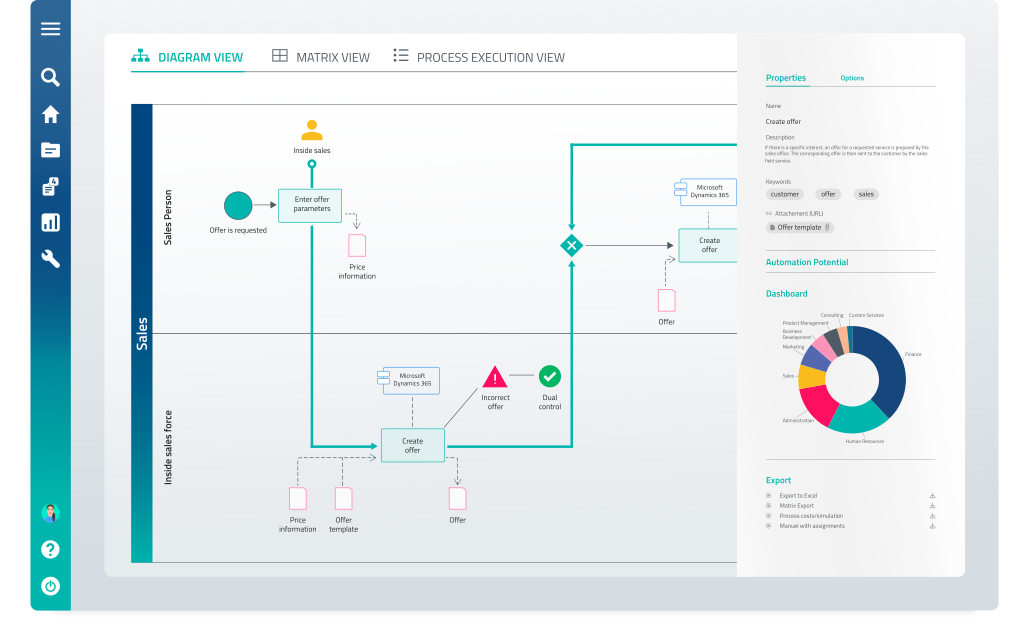
- Processes documented in GBTEC Process Design become the governed foundation for AI automation – structured, accurate and connected to the systems they run across.
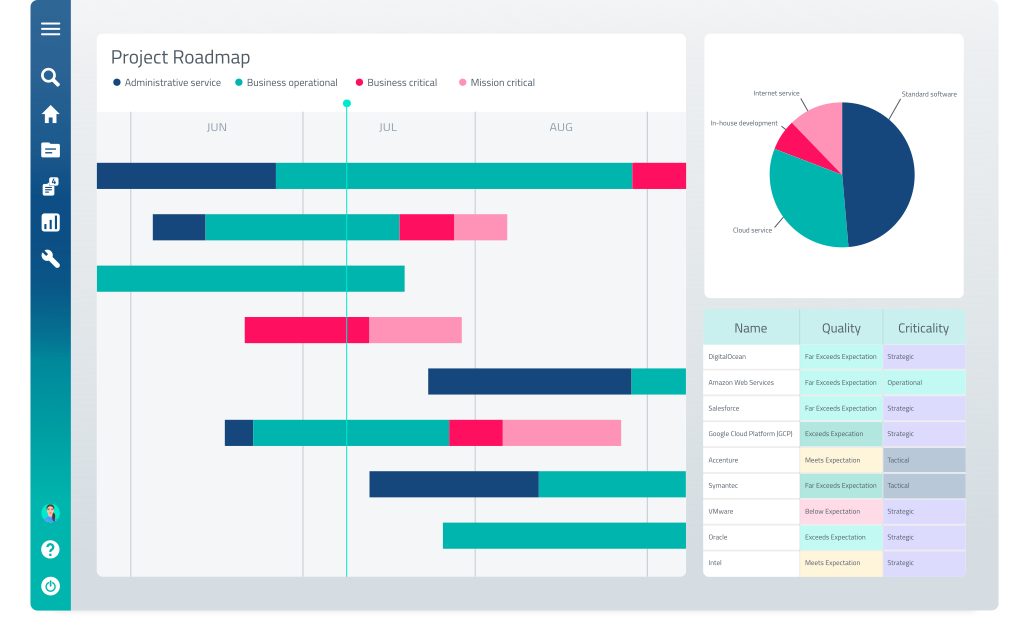
- GBTEC Enterprise Architecture maps the IT architecture layer, ensuring that AI agents operate within a clearly understood, auditable technology environment, with no hidden dependencies or ungoverned system interactions.
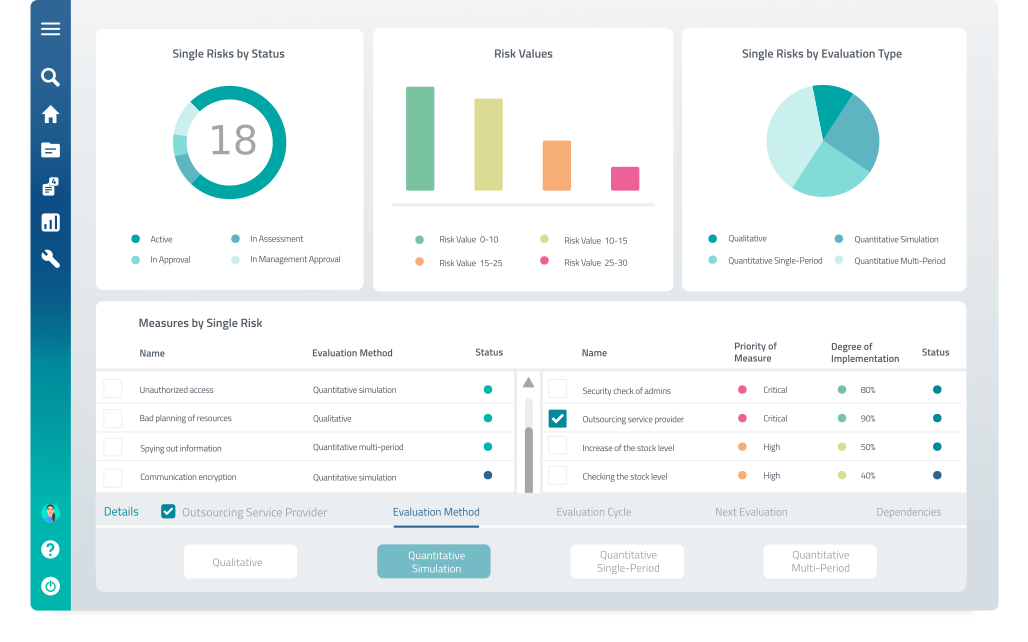
- GBTEC GRC Management embeds governance directly into processes and architecture so that when AI operates within a process, the risk and compliance context is already in place.
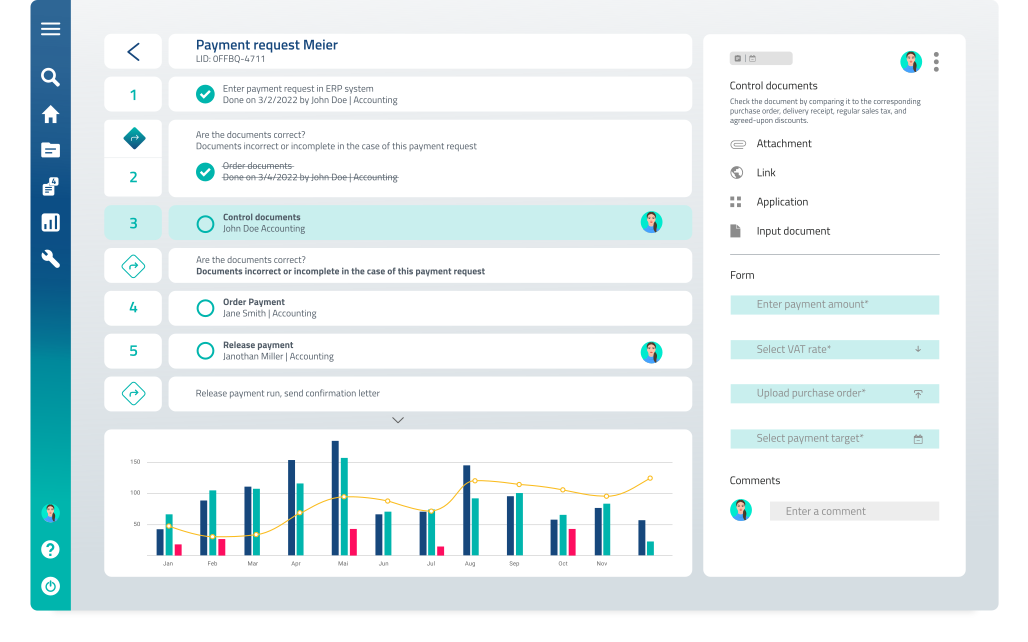
- GBTEC Work Orchestrator deploys AI process automation on top of this governed, architecturally grounded foundation, rather than on top of guesswork.
The EAM maturity roadmap for AI readiness
For organisations looking to close the AI-readiness gap, the following sequence provides a practical orientation toward a fully AI-enabled operating model:
- Establish process documentation as a strategic asset – governed, versioned and maintained as a living record of how the organisation operates.
- Connect every documented process to the IT systems and applications that support it – using GBTEC Enterprise Architecture to create the process-to-architecture bridge that AI deployment depends on.
- Embed governance and risk management within the process and architecture model – so that AI deployment operates within pre-defined, auditable boundaries from day one.
- Use the unified BPM + EAM + GRC foundation as the deployment platform for AI and automation – with full architectural visibility, AI governance architecture and enterprise-wide oversight already in place.
Frequently asked questions
Why does AI need Enterprise Architecture?
AI systems require a stable, documented, governed environment to operate effectively. Without knowing exactly how a process works, which systems it spans and what the governance boundaries are, AI cannot make reliable decisions or operate predictably at scale. Enterprise Architecture provides this foundation: it maps the relationship between processes and systems, defines the boundaries within which AI agents can act, and creates the audit trail that accountability requires.
Why does AI fail without process clarity?
When processes are undocumented, inconsistently maintained or disconnected from the systems they run across, AI has no reliable baseline to operate from. Predictive models cannot detect deviations if the baseline is inaccurate. Automation agents cannot follow a process they cannot see. And when AI makes a wrong decision in an ungoverned environment, there is no architecture model to diagnose what went wrong or why. The result is that AI-driven errors are scaled. The speed advantage of AI becomes a liability when the process underneath it is unstable.
What is an AI control tower architecture?
An AI control tower architecture is a centralised governance model that gives organisations visibility and oversight across all AI deployments, connected to the processes and systems each one operates within. Rather than managing AI initiatives in silos, a control tower approach uses the Enterprise Architecture layer as a single source of truth: tracking which AI agents are active, which processes they touch, what their boundaries are and whether they are operating within defined risk and compliance parameters.
How does AI governance architecture reduce risk?
AI governance architecture reduces risk by embedding compliance, accountability, and control boundaries directly into the processes and systems that AI operates within, rather than applying them retrospectively. When governance is built into the architecture layer from the outset, every AI deployment inherits a defined risk profile, a documented process context, and a clear audit trail. This means that when an AI system behaves unexpectedly, the organisation has the architectural record to understand why, where the boundary was exceeded and what remediation is required.
How does EAM support AI deployment?
EAM supports AI deployment by providing the architectural clarity that AI systems need to operate reliably. It maps which processes are ready for automation, which systems those processes run across and where the governance requirements sit. When EAM is unified with BPM and GRC in a single data model, organisations can assess AI readiness across their full process and technology landscape, deploy AI within governed boundaries and manage AI-driven changes with the same rigour as human-led ones.
GBTEC Software AG
Gesundheitscampus-Süd 23
44801 Bochum
Germany
