



Why your Enterprise Architecture model is already out of date (and what to do about it)
 24 June 2026
 Enterprise Architect models are meant to provide clarity in complex organisational structures. At their core, they are structured representations of business processes, applications, systems, and their independencies – showing how a company operates both operationally and technologically.
In reality, however, these models rarely stay accurate for long.
The architecture paradox
Here is a scenario that will sound familiar to many Enterprise Architects. You spend weeks – sometimes months – producing a comprehensive architecture model. It turns out accurate, detailed, and genuinely useful. You present it to the executive committee, they nod, and you publish it to the repository. In the meantime, the business keeps moving.
Six months later, someone pulls up that model to inform a transformation decision – and half of it is already out of date. Two of the systems you mapped have been modified; one process has been completely redesigned. The architecture is technically accurate as a historical document, but practically useless as a decision-making tool.
This is the architecture paradox: the effort invested in creating the Enterprise Architecture model is inversely related to how long it remains useful.
Why staleness is structural, not behavioural
The instinctive response to this problem is to invest in better governance: more frequent reviews, stronger change management processes, clearer ownership. These measures help at the margins, but they do not address the root cause.
That is because the root cause is structural. Traditional EAM software operates as a standalone system, disconnected from the operational layer of the business. It describes the architecture as it was designed to work – with no mechanism to automatically reflect what has changed, because it has no live connection to the processes that actually run the business.
Every time a process is redesigned, a system is modified, or a new application is deployed, the architecture model must be manually updated. In any organisation operating at pace, that means the model is almost always at least partially out of date. This is not a discipline problem but a structural limitation of how architecture information is captured and maintained.
The scale of the problem
GBTEC’s 2025 research across 600 business and operations leaders found that only 29% of organisations operate with a truly connected process environment – a single, shared, up-to-date source of truth. The remaining 71% are making transformation decisions against architecture data they cannot fully trust.
The process-architecture gap
The technical term for this structural disconnect is the process-architecture gap: the separation between how an organisation’s operational processes are documented and how its technology landscape is managed. When this gap exists, the consequences compound over time:
- Transformation projects discover architectural constraints at implementation rather than design, causing delays and rework.
- Process improvement initiatives create operationally viable workflows that are technically unsustainable.
- IT investment decisions are made without full visibility into which processes depend on the systems in question.
- AI and automation initiatives stall because neither the process layer nor the architecture layer is reliable enough to build on.
According to GBTEC’s research, 46% of organisations say the lack of alignment between process management, Enterprise Architecture and systems is actively preventing their transformation efforts. This is no longer a niche operational concern; it is becoming one of the defining constraints on enterprise transformation performance.
What a living architecture model looks like
Instead of answering that staleness problem with more manual review cycles, organisations that aim to operate at pace need a native integration between the process and architecture layers, so that when operational reality changes, their Enterprise Architecture model changes with it.
This is what a living architecture model delivers: a continuously current view of how the business operates and which systems support it.
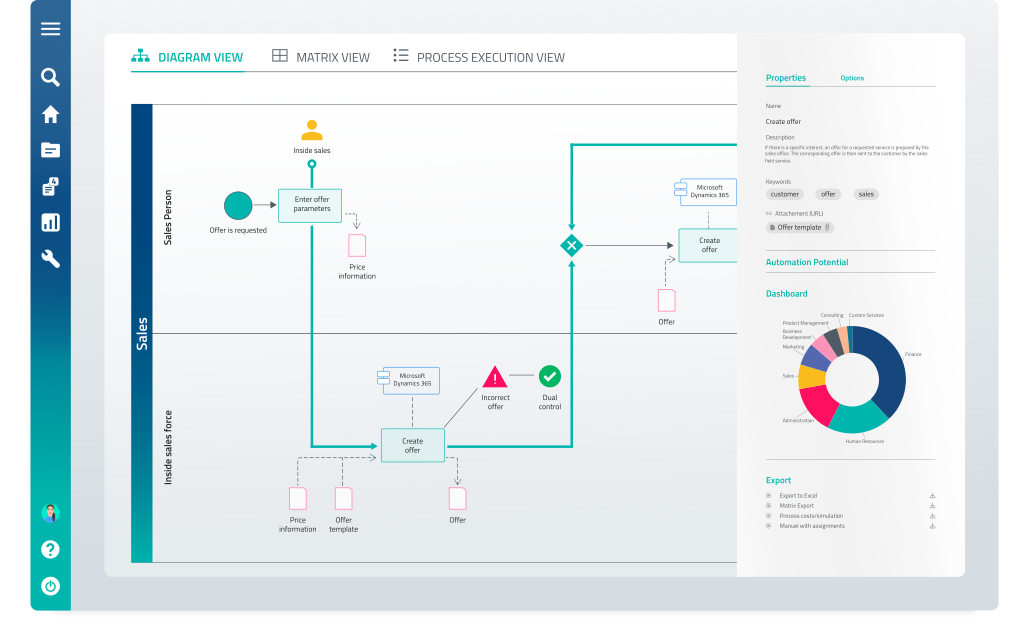
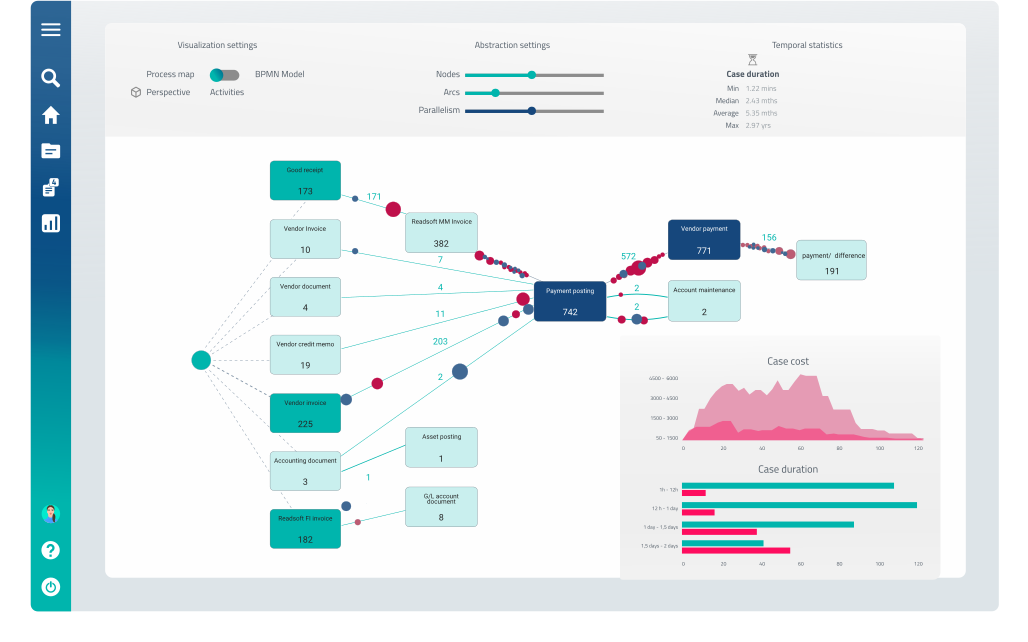
GBTEC Enterprise Architecture delivers exactly this as part of the Unified Transformation Suite. Because GBTEC Enterprise Architecture shares a single data model with GBTEC Process Design (BPM), the two layers are part of the same operational structure rather than just being connected through an integration. So, when a process is redesigned at the BPM layer, the architectural implications surface immediately in GBTEC Enterprise Architecture. And when a system is modified, the processes that depend on it become instantly visible.
The result is what Gartner describes as the foundation for a Digital Twin of an Organisation (DTO): a continuously connected operational model capable of supporting faster, more intelligent enterprise decisions.
“A Digital Twin of an Organisation helps Enterprise Architecture and technology innovation leaders prioritise, guide, plan, monitor, analyse, and scale complex initiatives.” – Gartner, Market Guide for Technologies Supporting a Digital Twin of an Organisation
Three questions to assess your architecture currency
If you are unsure whether your organisation has a staleness problem, these three questions will clarify quickly:
- When a system in your IT estate changes, how quickly does your Enterprise Architecture model reflect that change, and how do you verify it?
- When you redesign a business process, how do you assess whether your current technology infrastructure can support the new design?
- If your executive committee asked today for a real-time view of how your IT estate supports your three most critical business processes, what would you show them?
If any of these questions are difficult to answer with confidence, the process–architecture gap (and the absence of effective Enterprise Architecture governance) is already affecting your organisation.
Frequently asked questions
Why do Enterprise Architecture models become outdated?
Enterprise Architecture models become outdated because traditional EAM software maintains them manually, with no live connection to the processes and systems they describe. Every process change, system modification, or new deployment requires a separate update – and in organisations moving at pace, those updates fall behind almost immediately.
What is the process-architecture gap?
The process–architecture gap is the structural disconnect between how an organisation’s business processes are documented and how its technology landscape is managed. When these two layers operate in separate tools with no shared data model, the architecture model cannot reflect operational reality – leading to flawed transformation decisions, hidden system dependencies, and delayed project delivery.
What is a living architecture model?
A living architecture model is an Enterprise Architecture model that continuously reflects the current operational and technological state of an organisation. Rather than representing a fixed point-in-time view, it updates dynamically as processes are redesigned and systems change – making it a reliable foundation for transformation planning and decision-making.
Why is manual architecture maintenance inefficient?
Manual architecture maintenance requires a dedicated update every time a process changes or a system is modified. In large organisations, these changes happen continuously – and the effort required to keep the model current outpaces available capacity. The result is a model that is structurally always behind, regardless of how diligent the EA team is.
Why do transformation projects fail due to outdated architecture?
Outdated Enterprise Architecture models cause transformation projects to fail because teams base design decisions on a picture of the organisation that no longer reflects reality. Architectural constraints are discovered at implementation rather than at the design stage, triggering rework and delays. Process improvement initiatives may be operationally sound but technically unsustainable if the underlying systems cannot support the new design.
GBTEC Software AG
Gesundheitscampus-Süd 23
44801 Bochum
Germany
