




10 ways to make Enterprise Architecture more accurate, actionable and AI-ready with BIC EAM
 17 June 2026
 Enterprise Architecture Management (EAM)is only as valuable as it is current.
Yet most organisations are still navigating their IT landscape with Excel sheets, fragmented data and architecture models that lag behind reality. The result: missed optimisation opportunities, redundant systems, rising IT costs and transformation projects built on a false picture of the IT landscape.
The good news? These challenges are avoidable. Here are 10 practical ways to make Enterprise Architecture more accurate, actionable and AI-ready – and how BIC EAM helps organisations achieve exactly that.
1. Replace stale snapshots with a living IT model
One of the biggest challenges in Enterprise Architecture is keeping models up to date.
Enterprise Architecture models go stale for predictable reasons: changes to the IT landscape happen faster than documentation cycles, ownership of architecture data is fragmented across teams and manual updates – often managed in Excel – depend on individuals remembering to record changes. In most organisations, this creates a growing gap between the documented architecture and the actual state of IT systems and business operations.
BIC EAM addresses this directly.
By combining a central architecture repository, standard integrations and intuitive maintenance capabilities, it helps organisations replace static documentation with a living architecture model. Teams gain a single source of truth for their IT landscape, better visibility into dependencies and a stronger foundation for transformation, rationalisation and AI initiatives.
2. Build an architecture model that updates itself
Many architecture teams spend more time reconciling information than analysing it.
A living architecture modelis one that reflects the current state of an organisation’s IT systems, business capabilities and application dependencies continuously, rather than representing a snapshot taken during the last review cycle.
The concept matters because static documentation decays. A model created during an architecture review may already be partially outdated by the time that review concludes.
Decisions made on static shapshots carry risk: outdated data leads to faulty rationalisation, missed dependencies and underestimated exposure.
BIC EAM supports living architecture through several mechanisms: standard interfaces that allow external data sources to be integrated directly into the architecture model, an open meta-model that can be adapted as the organisation evolves and audit-proof version management that preserves historical architecture states while keeping the current model accurate. Architecture teams gain a model that can be updated continuously – not one that requires a dedicated project to refresh.
3. Connect process and architecture
Architecture decisions become risky when they are disconnected from operational reality.
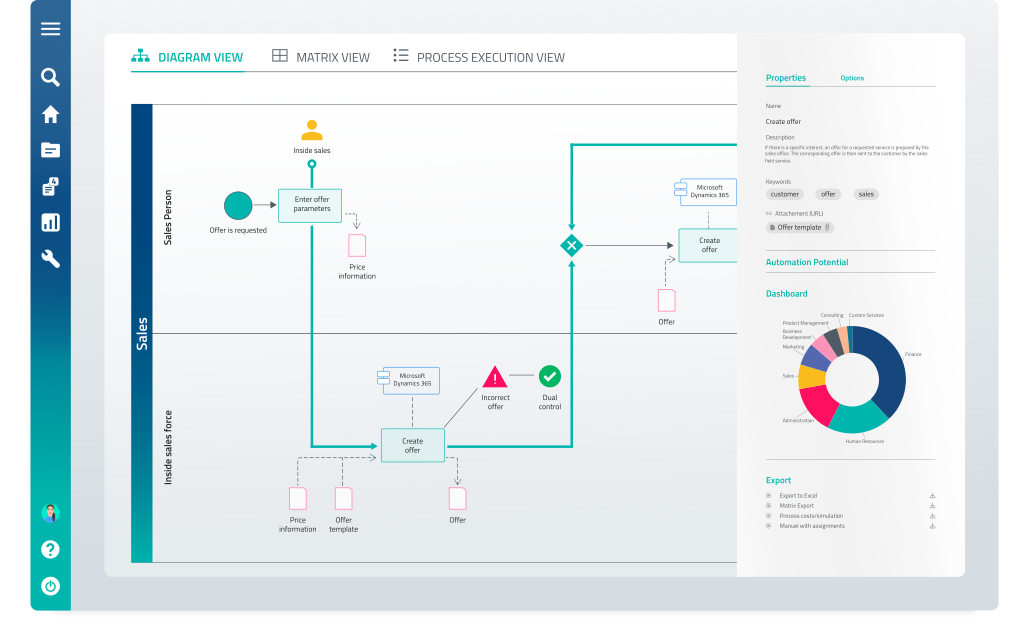
The process-architecture gaprefers to the disconnect between how an organisation’s processes operate and how those processes are reflected (or not) in the Enterprise Architecture model. This gap is one of the most underestimated sources of transformation failure.
When processes change without corresponding updates to the architecture model, architects make decisions based on a partial picture. Applications appear unnecessary when they are, in fact, critical to achieve processes. Dependencies are missed. Risk assessments are wrong.
BIC EAM closes this gap through full integration into Business Process Management (BPM). This means process context is not maintained separately from architecture data – it is connected within the same platform. When process and architecture are aligned, architects can assess IT impact more reliably, and process owners see relevant dependencies.
4. Detect outdated architecture elements automatically
Detecting outdated architecture elements at scale requires a combination of system integration, governed review workflows and analytics. Manual audit cycles are too slow and too infrequent to keep pace with organisational change.
BIC EAM provides several mechanisms for identifying and addressing stale architecture data:
- Standard interfaces and data integration: By connecting BIC EAM to external IT systems and data sources, changes in the actual IT landscape can be reflected in the architecture model without waiting for manual updates.
- AI-powered analytics: BIC EAM’s AI capabilities enable architects to identify connections and inconsistencies in complex IT architectures quickly – surfacing mismatches that would take days to find through manual analysis.
- Audit-proof version management: Historical architecture states are preserved, making it possible to compare current against past configurations and identify where drift has occurred.
This allows architecture teams to work from evidence rather than assumption – and to demonstrate the currency of their models to auditors, executives and transformation teams alike.
5. Cut manual maintenance with AI-powered automation
Manual architecture maintenance fails for structural reasons, not human ones. Even the most dedicated architecture teams cannot review every application, dependency and IT component at a pace modern organisations change – particularly when that maintenance depends on Excel files that only a handful of people know how to use correctly.
The core inefficiencies of manual, spreadsheet-based maintenance are:
- High update cost: Every change requires identification, documentation, review and approval – multiplied across hundreds or thousands of architecture objects.
- No change detection: Without automated monitoring or system integrations, outdated elements persist undetected until they cause problems.
- Access barriers: When architecture data lives in specialist tools or complex spreadsheets, most stakeholders cannot contribute updates or consume insights directly.
- No audit trail: Excel-based architecture has no built-in version control, making it impossible to reconstruct historical states or demonstrate compliance.
BIC EAM replaces manual maintenance with a governed architecture repository. Interfaces integrate system data, simplified inputs enable contributions and audit-proof versioning replaces file-based tracking. Temas shift to strategic decision support.
6. Give every stakeholder the view they need
CIOs need Enterprise Architecture to answer three questions: Where are we now? Where do we need to be? And what is the fastest, safest path between the two?
Traditional EAM tools and Excel-based approaches are poorly equipped for all three, and they produce outputs that only architecture specialists can read.
BIC EAM supports different stakeholders with tailored views of architecture data. Dashboards adapt to specific needs, from portfolio overviews to dependency or risk perspectives.
CIOs gain:
- Visibility into the IT landscape, including dependencies and lifecycle status
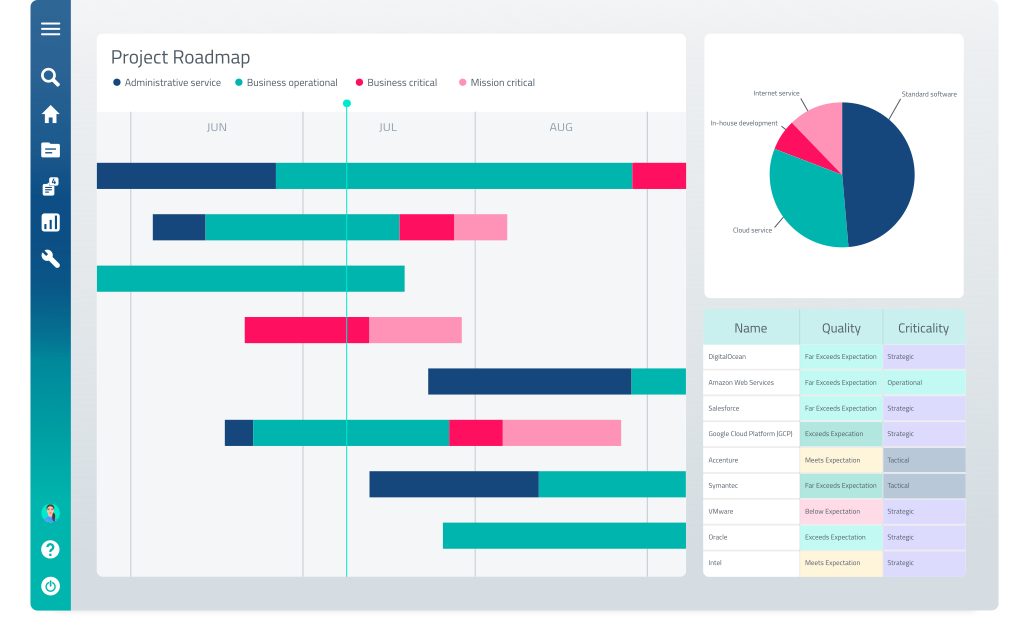
- Support for roadmap planning and transformation tracking
- Governance transparency with traceable controls
7. Turn architecture data into executive decisions
The reason Enterprise Architecture rarely reaches the boardroom is not a content problem – it is a presentation problem. Architecture teams produce technically accurate artefacts that require specialist knowledge to interpret. Executives need decisions, not diagrams.
BIC EAM supports this translation through customisable dashboards tailored for every audience. A CIO using BIC EAM can present the following:
- IT redundancy analysis with quantified cost impact and rationalisation recommendations
- Application portfolio views mapped to strategic value and ROI
- Transformation roadmaps with dependency sequences and risk indicators
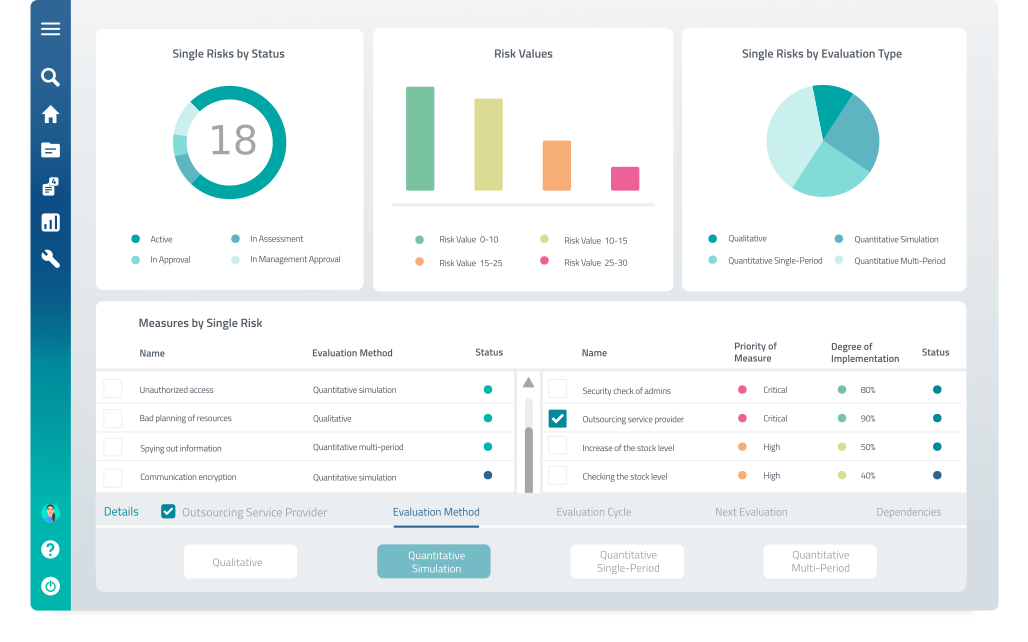
- Governance and compliance status relevant to regulators such as BaFin and BSI
Comparison: Traditional / Excel-based EAM vs. BIC EAM for CIO use cases
Capability | Traditional / Excel EAM | BIC EAM |
Current-state IT documentation | Partial | ✓ |
Standard interfaces for data integration | ✗ | ✓ |
Application portfolio management | ✗ | ✓ |
Architecture & roadmap planning | ✗ | ✓ |
AI-powered analytics | ✗ | ✓ |
Audience-specific dashboards | ✗ | ✓ |
Audit-proof version management | ✗ | ✓ |
This shifts the architecture conversation from “What systems do we have?” to “What decisions to we need to make?” – which is the conversation that belongs in the boardroom.
8. Build and validate a Target Operation Model
A Target Operation Model (TOM) defines the future-state design of an organisation: its capabilities, IT landscape and operational structure as they need to be to deliver the strategy. Building a TOM without accurate, current EAM data means planning against assumptions. With BIC EAM, it becomes a structured, evidence-based process.
The BIC EAM approach to TOM development:
- Define the target state by modelling capabilities and future architecture
- Identify gaps between current and target architecture objects
- Derive transformation roadmaps based on dependencies and priorities
- Keep the model aligned through continuous data integration
This enables broader validation beyond the architecture team.
9. Save up to 30% on IT costs through rationalisation
Most large organisations have more applications than they need.
Overlapping functionality, unused systems and legacy technologies create unnecessary complexity and cost.
The first step toward rationalisation is visibility.
This is where BIC EAM delivers some of its most tangible value.
It makes rationalisation systematic through three capabilities: portfolio visibility across applications, built-in reporting to identify redundancies, and continuous data integration to keep the landscape current.
10. Lay the foundation for responsible AI deployment
AI initiatives depend on clarity. AI systems require well-defined inputs, clear decision boundaries and transparent application dependencies. When the underlying IT landscape is undocumented – or documented only in outdated Excel files – AI deployments introduce unmanaged risk.
BIC EAM supports responsible AI deployment across four areas:
- Capture: An up-to-date view of the IT landscape through integrated data
- Analyse: Analytics to identify dependencies, risks and optimisation potential
- Integrate: Linking process context with architecture data
- Operate: Dashboards and versioning to support governance and oversight
Why this matters
Enterprise Architecture is evolving from a documentation discipline into a strategic capability. Organisations that maintain accurate, connected and actionable architecture models are better positioned to reduce costs, accelerate transformation and prepare for AI-driven change.
BIC EAM supports this shift by connecting Enterprise Architecture, Business Process Management and Governance, Risk & Compliance within GBTEC's Unified Transformation Suite, creating a living model of how the organisation actually works.
Discover how organisations are using BIC EAM to build living architecture models, optimise application portfolios and create a stronger foundation for transformation and AI.
Frequently asked questions
What is a living architecture model?
A living architecture model is one that reflects the current state of an organisation’s IT systems, business capabilities and application dependencies continuously, rather than representing a snapshot from the last review cycle. BIC EAM supports living architecture through standard data integration interfaces, an open meta-model that adapts as the organisation evolves, and audit-proof version management that keeps the current model accurate while preserving historical states.
What is the process-architecture gap, and how do you close it?
The process-architecture gap is the disconnect between how an organisation’s processes actually operate and how (or whether) those processes are reflected in the Enterprise Architecture model. It causes architects to make decisions based on an incomplete picture: applications look redundant when they are in fact critical, dependencies are missed and risk assessments underestimate exposure. BIC closes this gap by integrating EAM and BPM in one platform, connecting process context directly to architecture objects.
Why is Enterprise Architecture not reaching the boardroom?
The problem is translation, not content. Architecture teams produce technically accurate artefacts that require specialist knowledge to interpret. BIC EAM addresses this through audience-specific dashboards and customisable graphical and textual representations – so the CIO, the Business Unit Head and the Enterprise Architect each see the architecture data in the format most useful to their decisions, without requiring architectural expertise to read it.
What is AI readiness in Enterprise Architecture?
AI readiness means having the IT landscape clarity, application dependency visibility, capability maps and governance structures in place to deploy AI reliably and safely. It is not a one-time assessment but an ongoing capability that requires a continuously maintained architecture model. BIC EAM supports AI readiness through standard data integration, AI-powered analytics, EAM-BPM integration and audience-specific governance dashboards.
Why does AI fail without process clarity?
AI fails without process clarity because automation requires well-defined boundaries: where the AI acts, where human decisions remain and which systems and data sources the AI interacts with. Without documented process context connected to the IT architecture, those boundaries cannot be defined or governed. BIC EAM’s integration of EAM and BPM provides the process-architecture alignment that AI governance frameworks depend on.
GBTEC Software AG
Gesundheitscampus-Süd 23
44801 Bochum
Germany
